UK Emissions Trading Scheme: Regulating cross-boundary CCS pipelines
This consultation is open for responses
Closes 4 Jun 2026 (14 days remaining)
Summary
DESNZ proposes to simplify UK ETS permitting for cross-boundary CCS pipelines by reducing the number of permits required from multiple regulators to a maximum of two. Current rules require separate permits from each jurisdiction a pipeline crosses (England, Scotland, Wales, Northern Ireland, and offshore), plus monitoring infrastructure at each boundary. The consultation runs until 4 June 2026.
Why it matters
This is administrative streamlining for industrial decarbonisation infrastructure rather than electricity market reform. The measure reduces compliance costs for CCS operators but does not change electricity generation, grid access, or power market structure.
Key facts
- •Maximum of two UK ETS permits instead of current multi-jurisdictional requirements
- •Monitoring infrastructure reduced to maximum three sites: pipeline start, land/sea border, storage site
- •HyNet and East Coast Cluster projects can store 8.5 million tonnes CO2 annually from 2028
- •UK continental shelf has estimated 78 billion tonnes CO2 storage capacity
- •Two options: single onshore regulator throughout, or OPRED takes offshore responsibility
Timeline
Areas affected
Related programmes
Memo10,000 words
The Authority is seeking feedback on options being considered to streamline the UK Emissions Trading Scheme (ETS) regulatory requirements for cross-boundary CCS pipelines. The options aim to reduce the number of UK ETS permits a CCS pipeline crossing into multiple jurisdictions will require, which could simplify the monitoring and enforcement requirements for both operators and regulators. The consultation is aimed at anyone with an interest in CCS policy in the UK ETS, especially companies who plan to operate CCS pipelines. --- ## Introduction The UK Emissions Trading Scheme (ETS) is jointly run by the UK ETS Authority (hereafter ‘the Authority’) made up of the UK Government, Scottish Government, Welsh Government, and the Department of Agriculture, Environment and Rural Affairs for Northern Ireland (DAERA). Carbon capture and storage (CCS) will be crucial for the UK to meet its net zero targets, especially for hard to abate sectors such as steel, cement, and chemicals that lack alternatives for deep decarbonisation. Track-1 CCS projects that plan to transport carbon dioxide (CO2) from industrial clusters via pipeline to permanent geological storage have received their final investment decisions (FID) and plan to commence operations towards the end of this decade. Other CCS projects utilising a CO2 pipeline transport network are also planned and working towards the FID milestone. Pipeline transport of greenhouse gases intended for geological storage is currently regulated by the UK ETS. [[footnote 1]](#fn:1) However, the Authority has recognised the default permitting framework in the UK ETS could be amended to be less complex and burdensome for operators and regulators of CO2 pipeline transport networks that cross national boundaries in the UK (referred to in this document as ‘cross-boundary CCS pipelines’). This consultation seeks views on options that could simplify which regulator(s), in respect of the UK ETS, are responsible for permitting, monitoring compliance, and enforcement in respect of: * the onshore section of a cross-boundary CCS pipeline (i.e. the portion of the pipeline on land), and * the offshore section of a cross-boundary CCS pipeline (i.e. from when the pipeline enters UK waters). ## General information ### Why we are consulting The Authority is seeking feedback on options being considered to streamline the UK ETS regulatory requirements for cross-boundary CCS pipelines. The purpose of the consultation is to understand views on options to reduce the number of UK ETS permits a CCS pipeline crossing into multiple jurisdictions will require which could simplify the monitoring and enforcement requirements for both operators and regulators. ### Consultation details If you need a version of this document in a more accessible format, please email alt.formats@energysecurity.gov.uk. Please tell us what format you need. It will help us if you say what assistive technology you use. Issued: 12 March 2026 Respond by: 4 June 2026 Enquiries to: Emissions Trading Department for Energy Security and Net Zero Third Floor 3 Whitehall Place London SW1A 2EG Email: ukets.consultationresponses@energysecurity.gov.uk Consultation reference: UK Emissions Trading Scheme: Regulating cross-boundary CCS pipelines Audiences: * Companies proposing to offer CCS services, including capture installations, pipeline transport network operators, intermediate storage sites, and operators of geological stores. * UK ETS installations that are considering the use of pipeline CCS. * Any other potential participants in the CCS value chain. * Experts, academics, and organisations in the third sector with views on our proposed approach. * Verifiers and technical experts on monitoring, reporting, and verification (MRV). * Any other stakeholders with interest in our CCS policy options. Territorial extent: This consultation relates to options to develop the UK ETS, which operates across England, Scotland, Wales and Northern Ireland. This is a joint consultation, published by the UK Government, Scottish Government, Welsh Government and the Department of Agriculture, Environment and Rural Affairs for Northern Ireland. ### How to respond Respond online at: [UK Emissions Trading Scheme: Regulating cross-boundary CCS pipelines](https://energygovuk.citizenspace.com/_admin/energy-markets/uk-ets-regulating-cross-boundary-ccs-pipelines) or Email to: ukets.consultationresponses@energysecurity.gov.uk Write to: Emissions Trading Department for Energy Security and Net Zero Third Floor 3 Whitehall Place London SW1A 2EG When responding, please state whether you are responding as an individual or representing the views of an organisation. Your response will be most useful if it is framed in direct response to the questions posed, though further comments and evidence are also welcome. ### Confidentiality and data protection Information you provide in response to this consultation, including personal information, may be disclosed in accordance with UK legislation (the Freedom of Information Act 2000, the Data Protection Act 2018 and the Environmental Information Regulations 2004). If you want the information that you provide to be treated as confidential please tell us, but be aware that we cannot guarantee confidentiality in all circumstances. An automatic confidentiality disclaimer generated by your IT system will not be regarded by us as a confidentiality request. We will process your personal data in accordance with all applicable data protection laws. See our [privacy policy](https://www.gov.uk/government/publications/desnz-consultations-privacy-notice/privacy-notice-relating-to-consultation-responses-received-by-desnz). We will summarise all responses and publish this summary on [GOV.UK](https://www.gov.uk/search/policy-papers-and-consultations?parent=department-for-energy-security-and-net-zero&content_store_document_type%5B%5D=closed_consultations&content_store_document_type%5B%5D=closed_calls_for_evidence&organisations%5B%5D=department-for-energy-security-and-net-zero&order=updated-newest). The summary will include a list of names or organisations that responded, but not people’s personal names, addresses or other contact details. ### Quality assurance This consultation has been carried out in accordance with the [government’s consultation principles](https://www.gov.uk/government/publications/consultation-principles-guidance). If you have any complaints about the way this consultation has been conducted, please email: bru@energysecurity.gov.uk. ## Regulation of CCS pipelines that cross UK ETS regulatory boundaries Transport of greenhouse gases by pipelines for geological storage in a storage site is a regulated activity under the UK ETS. Operators of CCS pipelines therefore require UK ETS permits. CCS pipelines may need to traverse multiple UK ETS regulatory boundaries before reaching permanent geological storage sites offshore. Article 10 of the Greenhouse Gas Emissions Trading Scheme Order 2020 (‘The Order’) [[footnote 2]](#fn:2) sets out that for CCS pipelines: * The Environment Agency (EA) is the responsible regulator for UK ETS installations in England, * Secretary of State, whose regulator functions are delivered by the Offshore Petroleum Regulator for Environment and Decommissioning (OPRED) for UK ETS CCS activities, is responsible for installations in English territorial sea adjacent to England and the UK sector of the continental shelf (starting at 12 nautical miles offshore), * Natural Resources Wales (NRW) is the responsible regulator for Wales and Welsh territorial sea adjacent to Wales, * Scottish Environment Protection Agency (SEPA) is the responsible regulator for Scotland and Scottish territorial sea adjacent to Scotland, and * Northern Ireland Environment Agency (NIEA) is the responsible regulator for Northern Ireland and Northern Irish territorial sea adjacent to Northern Ireland. Under existing rules, this means responsibility for regulating the pipeline would transfer at each of these regulatory boundaries. Therefore, the operator would require a permit from each relevant regulator, and monitoring infrastructure to determine the amount of CO2 being transferred will be required at each boundary. In the case of a transfer of responsibility from the regulatory body for the relevant territorial sea (up to 12 nautical miles) to the regulatory body for the UK continental shelf (beyond 12 nautical miles), this boundary would be at sea. For example, a pipeline that ran through the territory of both England and Scotland, before terminating in an offshore geological storage site, would require a permit from the EA, a permit from SEPA, and a permit from OPRED, as well as monitoring infrastructure on the Scottish/English border and at the boundary between the Scottish territorial sea adjacent to Scotland and the UK sector of the continental shelf. There are also challenging practical issues inherent to any underwater infrastructure for installing and maintaining monitoring infrastructure at the point of transfer in to the UK sector of the continental shelf or between territorial seas. As it stands, these requirements increase both the complexity and the cost of constructing and operating a cross-boundary CCS pipeline. The Authority recognises that a more straightforward regulatory arrangement would be preferable. ### Determining the onshore regulator To streamline regulatory requirements, the Authority are considering the regulatory requirements where onshore pipelines cross over onshore UK borders, and whether they could only require a single UK ETS permit for the onshore portion of the pipeline. To facilitate this, we would need to identify the responsible UK ETS regulator/s. The Authority is considering two potential options for assigning regulatory responsibility for the onshore section of cross-boundary CCS pipelines. Option 1 – Assign a single onshore regulator Under this option, a single onshore UK ETS regulator would be designated for the entire onshore section of a cross-boundary CCS pipeline. This would entail existing regulator responsibilities being delegated from one regulator to another so they could regulate a cross-boundary CCS pipeline beyond their current jurisdiction. There are several possible approaches for determining how the onshore regulator could be assigned: * The regulator may be determined by the location of the pipeline’s central control room, where readings from monitoring equipment are processed and flow calculations are performed. For example, if the control room is located in Wales, NRW would act as the onshore regulator. * The regulator may be determined by the location of the pipeline operator’s UK-registered office. * The regulator may be determined by the jurisdiction through which the majority of the pipeline’s length passes. Whichever approach is taken to assign a single regulator, we propose that in cases of uncertainty, the Authority will be empowered to designate an appropriate onshore regulator for the pipeline. Option 2 – Jointly confer regulatory functions Under this option, regulatory responsibility for the onshore section of a cross-boundary CCS pipeline would be jointly conferred on all relevant UK ETS regulators whose jurisdictions the pipeline crosses. The relevant regulators would then agree on one lead regulator to exercise regulatory functions on behalf of the others. This decision would be based on which regulator is best placed to regulate the pipeline and will likely involve consideration of the above criteria set out for Option 1. Where a consensus is not reached amongst the regulators, the Authority will be empowered to designate an appropriate regulator for the pipeline. Regulators are involved from the planning stage of pipelines to assess other environmental regulatory requirements, so CCS pipeline projects would be identified early on by the relevant regulators, and deliberation could occur far in advance of when a permit is required. The pipeline operator would be informed by their regulator directly how they would be regulated and how to apply for a permit. Potential drawbacks of jointly conferring regulatory functions could include introducing legal uncertainty and complexity by requiring regulators to agree on responsibility. This approach may increase administrative efforts. Furthermore, the approach could reduce clarity on regulator enforcement powers and charging arrangements compared to the regulations clearly assigning a single onshore regulator. We do not anticipate that the regulator responsible for regulating a pipeline will change once initially determined, but if a need to do so arises, regulators would inform the pipeline operator in the year prior to the planned variation to their permit(s). We are interested in views from stakeholders on the most appropriate approach to determining the onshore regulator for cross-boundary CCS pipelines. Questions: 1. Do you agree that for onshore cross-boundary CCS pipelines there should be a requirement for only one onshore permit? 2. Do you have a preferred approach between Option 1 (assigning a single onshore regulator) and Option 2 (conferring joint regulatory functions on all relevant regulators)? Please explain your answer and provide evidence for your view where possible. 3. For Option 1, which criterion do you consider most appropriate for determining the onshore regulator? Please explain your answer and provide evidence where possible. 4. Are there any alternative criteria or approaches that should be considered for determining the onshore regulator of a cross-boundary CCS pipeline? If so, please describe the alternative criteria or approach and provide evidence where possible. ### Determining the offshore regulator We have previously presented the Authority view in the May 2019 consultation on the [Future of UK Carbon Pricing](https://assets.publishing.service.gov.uk/media/5d22f7d7ed915d0bc6a0a18f/THE_FUTURE_OF_UK_CARBON_PRICING_-_04072019.pdf) that for pipelines in England that are partially onshore and partially offshore, OPRED should be the regulator from the last point of measurement onshore before the CO2 is transported to the offshore storage site. In respect of pipelines located in Wales, Scotland and Northern Ireland that are partially onshore and partially offshore, the Authority proposed in the May 2019 consultation that DESNZ Secretary of State could seek consent from the relevant authority in those jurisdictions to direct OPRED as the regulator for CCS pipelines in their respective territories. This was to simplify the monitoring requirements, and mitigate the practical challenges associated with installing and maintaining monitoring infrastructure 12 nautical miles offshore where OPRED would take over regulatory responsibility from devolved regulators. Since then, the Authority has been considering applying a limit of two regulators for each cross-boundary CCS pipeline and correspondingly a maximum of two permits in total. To streamline the regulatory requirements in that manner, the Authority is considering two options for assigning regulatory responsibility for the offshore section of cross-boundary CCS pipelines. Option 1 – The onshore regulator remains the regulator for a cross-boundary CCS pipeline until the offshore storage site Each cross-boundary CCS pipeline, for the onshore and offshore sections, has only one regulator as determined by the onshore regulator options set out above (either EA, SEPA, NRW, or NIEA). This would also result in only one permit for the whole pipeline out to the storage site and, in turn, only require monitoring infrastructure at the start and end points of a CCS pipeline transport network – the end point being at the storage site. OPRED would remain the UK ETS regulator for the storage site where this site is located in the UK sector of the continental shelf or the territorial sea adjacent to England (i.e. the part of the territorial sea that is not adjacent to Northern Ireland, Scotland or Wales). Please note that each regulator, in respect of the UK ETS, only has the power to enact duties conferred on it by the Order, which due to the unique structure of the UK ETS is joint legislation made on behalf of the four national authorities that comprise the Authority, and other UK ETS legislation. Therefore, this option does not propose to confer additional powers on a Devolved Government or the UK Government and should not be interpreted as setting a precedent for widening the jurisdiction for other regulatory functions of any of the regulators. Option 2 – OPRED is the sole regulator for the entire offshore portion of the cross-boundary CCS pipeline including territorial seas and the UK sector of the continental shelf Each cross-boundary CCS pipeline has only one onshore regulator (either EA, SEPA, NRW, or NIEA), and OPRED is the sole offshore regulator where there will be a requirement for monitoring infrastructure at the onshore-to-offshore transfer point. This would also result in one permit for the offshore portion of the pipeline out to the storage site as well as one permit for the onshore portion. For this onshore-offshore transfer, the Authority considers that regulatory responsibility should pass to OPRED at the last onshore metering point, with OPRED then regulating the entire offshore portion of the pipeline. As with Option 1, this option does not confer additional powers on a Devolved Government or the UK Government and should not be interpreted as setting a precedent for widening the jurisdiction for other regulatory functions of any of the regulators. The next section of this document outlines options for monitoring infrastructure in respect of the offshore/onshore boundary in the event that Option 2 is pursued. Questions: 5. Do you have a preferred approach between Option 1 (the onshore regulator remains the regulator offshore) and Option 2 (OPRED is the sole offshore regulator)? Please explain your answer and provide evidence for your view where possible. 6. For Option 2, do you agree that OPRED’s regulatory responsibility should start from the last metering point at the designated onshore/offshore transfer point? Please explain your answer and provide evidence where possible. ### Monitoring infrastructure for the onshore/offshore boundary For Option 2 (OPRED is sole offshore regulator for CCS pipelines that cross into the UK sector of the continental shelf), monitoring infrastructure (e.g., a CEMS [[footnote 3]](#fn:3) or AMS [[footnote 4]](#fn:4)) will be required to monitor CO2 transferred across a regulatory boundary from the onshore regulator to OPRED. This is also currently required at the existing transfer point between the EA and OPRED at an English shore under current rules. The CCS pipeline operator must annually report to their regulator how much CO2 is lost from venting, leakage, and fugitive emissions, as well as the quantity of CO2 that has been transported to the offshore storage site. The boundary provides that end and start point for the onshore and offshore regulator respectively. This ensures the UK ETS robustly accounts for the net amount of greenhouse gas geologically stored. Thus, we are seeking views on the appropriate requirements for pipeline monitoring infrastructure. It may be possible to use existing onshore monitoring/metering so that it becomes the designated last onshore meter. Alternatively, the Authority could mandate that additional metering and other monitoring infrastructure be constructed at a suitable onshore point near the pipeline beachhead, which would then be the point of regulatory transfer to OPRED. For both these eventualities, to ensure that OPRED’s onshore responsibility extends no further than necessary, we recommend that the point of transfer, along with associated infrastructure, be onshore at a maximum of 2 km from the mean high-water springs mark (the average high tide line during spring tides) at the pipeline beachhead. Questions: 7. Do you agree that dedicated monitoring and metering infrastructure should be required at the point of regulatory transfer between the onshore and offshore regulator? Please explain your answer and provide evidence for your view where possible. 8. What are your views on our proposed approach to monitoring infrastructure requirements for the onshore-offshore transfer? Please explain your answer and provide evidence where possible. 9. Do you agree that the appropriate distance for determining the location of the onshore/offshore transfer point should be no greater than 2 km from the mean high-water springs? Please explain your answer and provide evidence where possible. ### Compliance and monitoring infrastructure costs The Authority is interested in developing its understanding of monitoring infrastructure costs (capital and operational) as well as costs from the administrative effort to Monitor, Report, and Verify (MRV) emissions for each section of the pipeline separately in the event that none of the options in this consultation are taken forward. The Analytical Annex details our current understanding, and we would like to invite stakeholders to provide any relevant data on these costs if available. Question: 10. If you have cost data you are willing to share either on monitoring infrastructure and/or the expected cost of UK ETS MRV for pipelines transporting CO2 to permanent geological storage, please provide this and accompany with evidence where possible. ### Welsh language Questions: 11. What, in your opinion, would be the likely effects of the options being consulted on have on the Welsh language? We are particularly interested in any likely effects on opportunities to use the Welsh language and on not treating the Welsh language less favourably than English. Do you think that there are opportunities to promote any positive effects? Do you think that there are opportunities to mitigate any adverse effects? 12. In your opinion, could the options being consulted on be formulated or changed so as to have positive effects or more positive effects on using the Welsh language and on not treating the Welsh language less favourably than English; or mitigate any negative effects on using the Welsh language and on not treating the Welsh language less favourably than English? ## Consultation questions 1. Do you agree that for onshore cross-boundary CCS pipelines there should be a requirement for only one onshore permit? 2. Do you have a preferred approach between Option 1 (assigning a single onshore regulator) and Option 2 (conferring joint regulatory functions on all relevant regulators)? Please explain your answer and provide evidence for your view where possible. 3. For Option 1, which criterion do you consider most appropriate for determining the onshore regulator? Please explain your answer and provide evidence where possible. 4. Are there any alternative criteria or approaches that should be considered for determining the onshore regulator of a cross-boundary CCS pipeline? If so, please describe the alternative criteria or approach and provide evidence where possible. 5. Do you have a preferred approach between Option 1 (the onshore regulator remains the regulator offshore) and Option 2 (OPRED is the sole offshore regulator)? Please explain your answer and provide evidence for your view where possible. 6. For option 2, do you agree that OPRED’s regulatory responsibility should start from the last metering point at the designated onshore/offshore transfer point? Please explain your answer and provide evidence where possible. 7. Do you agree that dedicated monitoring and metering infrastructure should be required at the point of regulatory transfer between the onshore and offshore regulator? Please explain your answer and provide evidence for your view where possible. 8. What are your views on our proposed approach to monitoring infrastructure requirements for the onshore-offshore transfer? Please explain your answer and provide evidence where possible. 9. Do you agree that the appropriate distance for determining the location of the onshore/offshore transfer point should be no greater than 2 km from the mean high-water springs? Please explain your answer and provide evidence where possible. 10. If you have cost data you are willing to share either on monitoring infrastructure and/or the expected cost of UK ETS MRV for pipelines transporting CO2 to permanent geological storage, please provide this and accompany with evidence where possible. 11. What, in your opinion, would be the likely effects of the options being consulted on have on the Welsh language? We are particularly interested in any likely effects on opportunities to use the Welsh language and on not treating the Welsh language less favourably than English. Do you think that there are opportunities to promote any positive effects? Do you think that there are opportunities to mitigate any adverse effects? 12. In your opinion, could the options being consulted on be formulated or changed so as to have positive effects or more positive effects on using the Welsh language and on not treating the Welsh language less favourably than English; or mitigate any negative effects on using the Welsh language and on not treating the Welsh language less favourably than English? ## Next steps The responses to this consultation will be used to develop final policy decisions for implementation. The consultation will be open for 12 weeks before closing. The Authority will then work through the responses and aim to publish the Authority Response in due course. ## Annex – Analytical summary ### UK ETS background The UK Emissions Trading Scheme (UK ETS) is one of the UK’s flagship decarbonisation policy instruments. UK ETS covers emissions in heavy industry, power generation and aviation. [[footnote 5]](#fn:5) The scheme will expand to include domestic maritime emissions from July 2026. Consultations have been held on further scope expansion to waste incineration, energy from waste and international maritime emissions. In 2023, UK territorial emissions totalled approximately 385 million tonnes (Mt) of CO2 of which around 25% (97Mt of CO2) were covered by the UK ETS main scheme. 2024 saw a decrease in emissions covered by the UK ETS of 11Mt of CO2, driven largely by emissions reductions in the power sector and industry. [[footnote 6]](#fn:6) UK ETS operators must obtain allowances (purchased in auctions and in the secondary market or freely allocated) and surrender them to cover their emissions liability. This ability of market participants to trade allowances ensures that decarbonisation in the covered sectors in the scheme happens at the least cost as a choice is always made between the purchasing allowances or reducing emissions through deploying a green technology. Under the “cap and trade” principle of the UK ETS, the number of allowances available under the cap each year decreases, ensuring alignment with the proposed emissions reductions required under our long-term net zero goals. The UK ETS is therefore a policy instrument to incentivise decarbonisation through adoption of existing and novel technologies. ### CCS summary One such technology is carbon capture and storage (CCS) where CO2 is prevented from entering the atmosphere by capturing it at production source. Once captured, it is compressed and transported to long-term geological storage. CCS is viewed as an essential technology for the UK to achieve its 2050 net zero goal, to support economic growth and create high-value, low-carbon jobs in industrial regions. [[footnote 7]](#fn:7) This consultation seeks to simplify the permitting arrangements for CCS pipeline operators. By simplifying the regulatory boundaries for cross-boundary permitting in the UK the administrative effort incurred by CCS pipeline operators should be reduced. Making operations more efficient should, in turn, help support the economic viability of CCS. UK ETS operators which utilise pipeline-based CCS to reduce their emissions could benefit from reduced pass-through costs, supporting adoption of the technology. ### Analytical summary UK ETS installations and operators are geographically dispersed throughout the UK, whilst the majority of the 78 billion tonnes of CO2 storage [[footnote 8]](#fn:8) in the UK continental shelf is located within the North Sea. Other storage sites are within the Irish Sea and the English Channel. Figure 1 at A [[footnote 9]](#fn:9) shows the geographic distribution of ETS installations and operators across the UK and at B [[footnote 10]](#fn:10) shows the geographic distribution of offshore geological storage. Figure 1A 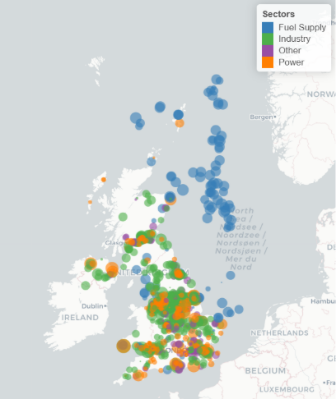 Figure 1B 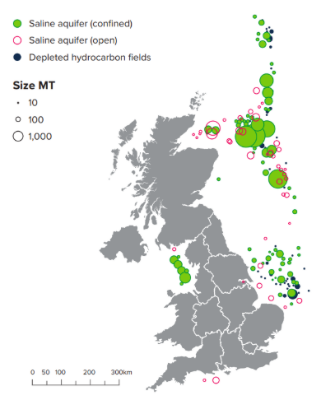 Each of the four nations of the UK has their own regulator which oversees UK ETS regulated activity. Each regulator has jurisdiction over UK ETS installations on land and devolved regulators have jurisdiction over UK ETS installations in their nation’s territorial sea (within 12 nautical miles of the shore). In addition, there is a regulator, OPRED, for offshore UK ETS installations beyond the 12 nautical mile boundary that also has jurisdiction over the English territorial sea. Under current rules, CCS pipelines which traverse these boundaries will be required to obtain a separate UK ETS permit for each jurisdiction. From figure 1 above, captured CO2 from UK ETS installations is likely to be transported across regulatory jurisdictional boundaries by pipelines. This highlights the need to ensure the regulatory framework allows CO2 transported by a pipeline to storage across national boundaries (including the transition from land to sea) is robust yet practical to facilitate adoption by operators of UK ETS installations. Figure 2 – HyNet regulatory status quo and options under consideration. 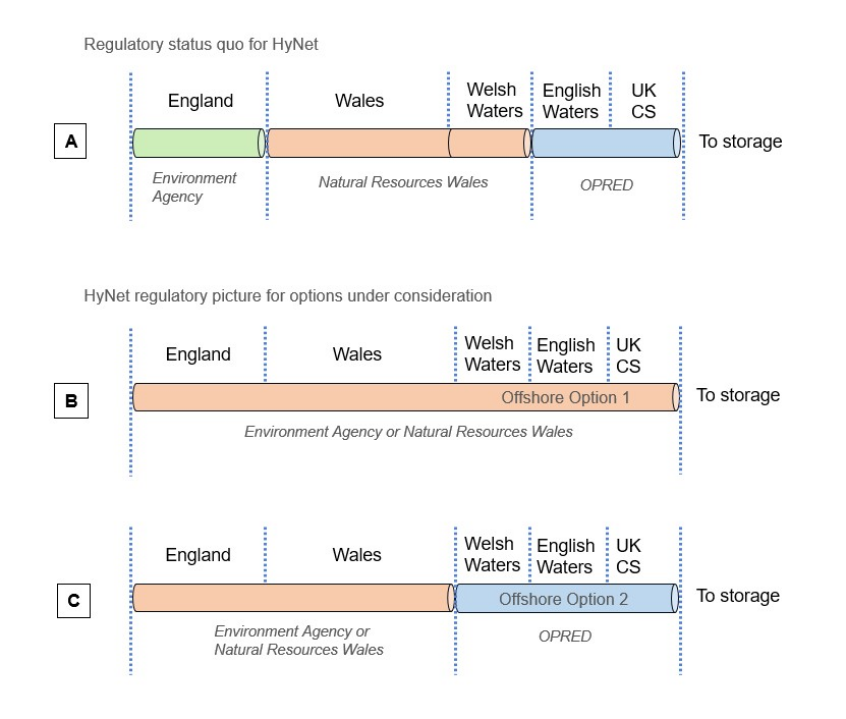 Figure 2A demonstrates the current regulatory framework that the HyNet Transport and Storage Network [[footnote 11]](#fn:11) will have to adhere to once in operation if none of the options considered in the consultation are implemented. The pipeline starts under the jurisdiction of the Environment Agency (EA; regulator in England). As the pipeline crosses the border into Wales, Natural Resources Wales (NRW; regulator in Wales) has responsibility for the section of pipeline from the England/Wales border and into Welsh territorial sea. At the boundary between the Welsh and English territorial sea, the Offshore Petroleum Regulator for Environment and Decommissioning (OPRED; UK regulator) takes over regulatory responsibility through into the UK sector of the continental shelf (UK CS) until the storage site. Please note, if the UK CS was bordering the territorial sea of a devolved nation, the responsibility would pass from the devolved regulator to OPRED at the boundary between the devolved territorial sea and the UK CS. At each of the boundary points for HyNet, indicated with the longer dashed blue lines, monitoring infrastructure is installed to determine the amount of CO2 being transferred as per each permit’s monitoring plan which are agreed with each regulator. As an example, two of the options in this consultation are demonstrated in figures 2B and 2C. A criterion or multiple criteria would be used to determine which single regulator (EA or NRW) would be responsible for the onshore section of the HyNet pipeline. In addition, that regulator would either remain the regulator offshore or OPRED would become the sole regulator for the offshore portion. Overall, the HyNet pipeline operator would engage with a maximum of two regulators under the options being considered and the requirement for monitoring infrastructure would be reduced to a maximum of three sites: the start of the pipeline, the land/sea border and the start of the storage site. Under the existing regulatory framework, pipeline operators are subject to two principal categories of cost: 1. Compliance costs These costs arise from the requirement to obtain and maintain permits in each jurisdiction the pipeline traverses. Each permit requires operators to pay set-up and annual fees to their regulator. However, the larger cost comes from the complexity of these processes which can be administratively burdensome on operators resulting from engaging with different regulators for different sections of the pipeline to obtain UK ETS permits. Whilst we anticipate the policy to reduce administrative costs, we are unable to estimate them quantitatively. The latest evidence on compliance costs accrued from UK ETS operators dates back to 2016 when UK ETS operators operated under EU ETS rules. However, operators who provided data for this study did not split out the costs associated with permits specifically, so it is not clear what proportion of these costs are derived from the permitting process. In addition, UK ETS operators now operate under UK ETS regulations which have diverged from EU ETS regulations and so this evidence serves as a proxy to understand the impact of this proposed policy on compliance costs under UK ETS regulations. As demonstrated by figure 2A and 2B for HyNet, the consultation options would mean a CCS pipeline operator would engage with a maximum of two regulators (down from three in the case of HyNet). Thus, under the options considered in this consultation, a CCS pipeline operator would save on the fees paid to regulators and administrative costs associated with engaging with less regulators to obtain the necessary permit and report emissions under the monitoring plan. 2. Infrastructure costs At jurisdictional boundaries, operators are required to install monitoring infrastructure to ensure accurate measurement and reporting for each permit. In cases where the pipeline traverses the boundary of a devolved territorial sea (at 12 nautical miles of the shore) to the UK sector of the continental shelf or from one territorial sea to another, monitoring infrastructure must be installed subsea. As demonstrated in figure 2A and 2B for HyNet, the number of points where monitoring infrastructure will be required due to a boundary would be reduced from three to one or zero; in addition to the monitoring infrastructure required at the start and end points of a CCS pipeline. This would reduce capital expenditure (to purchase and fit the equipment) and operating expenditure (to maintain and operate the equipment). Whilst we anticipate these cost reductions, we are unable to quantify them. The equipment used in large scale projects such as HyNet are largely bespoke to an individual project’s specification, therefore, no ‘off-the-shelf’ cost estimates are available to quote. Currently, there are no operational CCS pipelines in the UK. In addition to the HyNet Transport and Storage Network, the East Coast Cluster [[footnote 12]](#fn:12) is also in construction. Both projects target commencing operations in 2028 and together can store 8.5 million tonnes of carbon emissions each year. This would equate to approximately 0.01% of the UK Continental Shelf’s estimated storage capacity each year and around 16% of the 2028 legislated cap [[footnote 13]](#fn:13). The government has announced its support for two additional clusters that are in development (Acorn in Northern Scotland [[footnote 14]](#fn:14) and Viking in Humber [[footnote 15]](#fn:15)) and is providing the development funding to advance their delivery. Contracts have been agreed for various projects including those in the power generation and cement production sectors (UK ETS regulated activities) to begin using carbon capture technology and utilise the HyNet network [[footnote 16]](#fn:16). ### Conclusion Overall, there is clear evidence of the scale of CCS development and the significant potential it offers for UK ETS operators to effectively decarbonise. The geographic distribution of UK ETS industrial sites compared to permanent geological storage indicates that cross boundary transportation of captured carbon dioxide via pipeline is highly likely. The options considered as part of this consultation are expected to simplify the regulatory framework for CCS pipeline operators. This will minimise fees paid to regulators and administrative burden on the pipeline operator, reducing any pass-through operating costs therefore making CCS a more attractive proposition for UK ETS operators seeking to decarbonise. Going forward, we seek to develop our understanding on infrastructure costs (capital and operational) as well as costs from administrative effort through permitting and reporting to regulators. We would like to invite stakeholders to provide any useful data on these costs if available. 1. [Paragraph 3 of Schedule 2, The Greenhouse Gas Emissions Trading Scheme Order 2020](https://www.legislation.gov.uk/uksi/2020/1265/schedule/2) [↩](#fnref:1) 2. [Article 10, The Greenhouse Gas Emissions Trading Scheme Order 2020](https://www.legislation.gov.uk/uksi/2020/1265/article/10). [↩](#fnref:2) 3. Continuous Emissions Monitoring System – measures both the mass and concentration of the gas flowing through the pipeline. [↩](#fnref:3) 4. Automated Measuring System – measures the mass of the gas flowing through the pipeline (concentration will be calculated via emissions factors). [↩](#fnref:4) 5. [UK Emissions Trading Scheme (UK ETS): a policy overview - GOV.UK](https://www.gov.uk/government/publications/uk-emissions-trading-scheme-uk-ets-policy-overview/uk-emissions-trading-scheme-uk-ets-a-policy-overview). [↩](#fnref:5) 6. Internal DESNZ analysis of UK ETS data. [↩](#fnref:6) 7. [CCUS future network strategy - GOV.UK](https://www.gov.uk/government/calls-for-evidence/ccus-future-network-strategy). [↩](#fnref:7) 8. [Carbon capture, usage and storage: a vision to establish a competitive market - GOV.UK](https://www.gov.uk/government/publications/carbon-capture-usage-and-storage-a-vision-to-establish-a-competitive-market) (DESNZ, 2023). [↩](#fnref:8) 9. Internal DESNZ analysis of UK ETS data. [↩](#fnref:9) 10. [Carbon capture, usage and storage: a vision to establish a competitive market - GOV.UK](https://www.gov.uk/government/publications/carbon-capture-usage-and-storage-a-vision-to-establish-a-competitive-market) (DESNZ, 2023). [↩](#fnref:10) 11. [HyNet North-West](https://hynet.co.uk/). [↩](#fnref:11) 12. [East Coast Cluster](https://eastcoastcluster.co.uk/). [↩](#fnref:12) 13. The legislated cap in 2028 is 53,498,502 tonnes as set out in [Article 22, The Greenhouse Gas Emissions Trading Scheme Order 2020](https://www.legislation.gov.uk/uksi/2020/1265/article/22). Note that not all CO2 transported by the HyNet and East Coast Clusters may be from UK ETS regulated activity. It should be noted that these projects are unlikely to operate at full capacity immediately upon commencement. Therefore, the 16% figure is intended to illustrate the relative scale of operations compared to the legislated cap, rather than imply HyNet and the East Coast Cluster will collectively capture 16% of the cap in 2028. [↩](#fnref:13) 14. Acorn: [Growing Our Decarbonised Future - The Acorn Project](https://theacornproject.uk/). [↩](#fnref:14) 15. Humber CCS: [Carbon Capture and Storage - Viking CCS](https://www.vikingccs.co.uk/). [↩](#fnref:15) 16. [HyNet expansion: project negotiation list - GOV.UK](https://www.gov.uk/government/publications/hynet-track-1-expansion-selected-projects/hynet-expansion-project-negotiation-list). [↩](#fnref:16) --- Ymgynghoriad ar y cyd rhwng Llywodraeth y DU, Llywodraeth yr Alban, Llywodraeth Cymru ac Adran Amaethyddiaeth, Amgylchedd a Materion Gwledig Gogledd Iwerddon ## Cyflwyniad Mae Cynllun Masnachu Allyriadau’r DU (ETS y DU) yn cael ei redeg ar y cyd gan Awdurdod Cynllun Masnachu Allyriadau’r DU (‘yr Awdurdod’ o hyn ymlaen) sy’n cynnwys Llywodraeth y DU, Llywodraeth yr Alban, Llywodraeth Cymru ac Adran Amaethyddiaeth, yr Amgylchedd a Materion Gwledig Gogledd Iwerddon. Bydd dal a storio carbon (CCS) yn hanfodol er mwyn i’r DU gyrraedd ei thargedau sero net, yn enwedig ar gyfer sectorau anodd eu lleihau fel dur, sment, a chemegau sydd heb ddewisiadau amgen ar gyfer datgarboneiddio dwfn. Mae prosiectau Trac-1 CCS sy’n bwriadu cludo carbon deuocsid (CO2) o glystyrau diwydiannol trwy biblinellau i safleoedd storio daearegol parhaol wedi derbyn eu penderfyniadau buddsoddi terfynol (FID) ac maent yn bwriadu dechrau gweithredu tua diwedd y degawd hwn. Mae cynlluniau eraill ar gyfer prosiectau CCS sy’n defnyddio rhwydwaith trafnidiaeth piblinellau CO2 hefyd ar y gweill ac yn gweithio tuag at garreg filltir y FID. Ar hyn o bryd mae cludo nwyon tŷ gwydr a fwriedir ar gyfer safleoedd storio daearegol yn cael ei reoleiddio gan ETS y DU. [[footnote 1]](#fn:1) Fodd bynnag, mae’r Awdurdod wedi cydnabod y gellid diwygio’r fframwaith trwyddedu diofyn yn ETS y DU i fod yn llai cymhleth a beichus i weithredwyr a rheoleiddwyr rhwydweithiau trafnidiaeth piblinellau CO2 sy’n croesi ffiniau cenedlaethol yn y DU (y cyfeirir atynt yn y ddogfen hon fel ‘piblinellau CCS trawsffiniol’). Mae’r ymgynghoriad hwn yn gofyn am farn ar opsiynau a allai symleiddio pa reoleiddiwr/reoleiddwyr, mewn perthynas ag ETS y DU, sy’n gyfrifol am drwyddedu, monitro cydymffurfiaeth a gorfodi mewn perthynas â: * y rhan ar y tir o biblinell CCS drawsffiniol (h.y. y rhan o’r biblinell ar y tir), a * y rhan ar y môr o biblinell CCS drawsffiniol ar y môr (h.y. lle y mae’r biblinell yn mynd i ddyfroedd y DU). ## Gwybodaeth gyffredinol ### Pam rydyn ni’n ymgynghori Mae’r Awdurdod yn gofyn am adborth ar opsiynau sy’n cael eu hystyried i symleiddio gofynion rheoleiddiol ETS y DU ar gyfer piblinellau CCS trawsffiniol. Diben yr ymgynghoriad yw deall safbwyntiau ar opsiynau er mwyn lleihau nifer y trwyddedau ETS y DU y bydd eu hangen ar biblinell CCS sy’n croesi i awdurdodaethau lluosog a allai symleiddio’r gofynion monitro a gorfodi ar gyfer gweithredwyr a rheoleiddwyr. ### Manylion yr ymgynghoriad Os oes angen fersiwn o’r ddogfen hon arnoch mewn fformat mwy hygyrch, anfonwch e-bost at alt.formats@energysecurity.gov.uk. Dywedwch wrthym pa fformat sydd ei angen arnoch. Bydd yn ein helpu os dywedwch pa dechnoleg gynorthwyol rydych yn ei ddefnyddio. Cyhoeddwyd: 12 Mawrth 2026 Ymateb erbyn: 4 Mehefin 2026 Ymholiadau i: Emissions Trading Department for Energy Security and Net Zero Third Floor 3 Whitehall Place London SW1A 2EG Ebost: ukets.consultationresponses@energysecurity.gov.uk Cyfeirnod yr ymgynghoriad: Cynllun Masnachu Allyriadau’r DU: Rheoleiddio piblinellau dal a storio carbon trawsffiniol y DU Cynulleidfaoedd: * Cwmnïau sy’n bwriadu cynnig gwasanaethau CCS, gan gynnwys safleoedd dal, gweithredwyr rhwydwaith cludo piblinellau, safleoedd storio canolradd, a gweithredwyr storfeydd daearegol. * Safleoedd ETS y DU sy’n ystyried defnyddio piblinellau CCS. * Unrhyw gyfranogwyr posibl eraill yn y gadwyn werth CCS. * Arbenigwyr, academyddion, a sefydliadau yn y trydydd sector â barn ar ein dull arfaethedig. * Dilyswyr ac arbenigwyr technegol ar fonitro, adrodd a dilysu (MRV). * Unrhyw randdeiliaid eraill â diddordeb yn ein hopsiynau polisi CCS. Ehangder tiriogaethol: Mae’r ymgynghoriad hwn yn ymwneud ag opsiynau i ddatblygu ETS y DU, sy’n gweithredu ledled Cymru, Lloegr, yr Alban, a Gogledd Iwerddon. Mae hwn yn ymgynghoriad ar y cyd, a gyhoeddwyd gan Lywodraeth y DU, Llywodraeth yr Alban, Llywodraeth Cymru ac Adran Amaethyddiaeth, yr Amgylchedd a Materion Gwledig Gogledd Iwerddon. ### Sut i ymate Ymatebwch ar-lein yn: [energygovuk.citizenspace.com/energy-markets/uk-ets-regulating-cross-boundary-ccs-pipelines/](https://energygovuk.citizenspace.com/energy-markets/uk-ets-regulating-cross-boundary-ccs-pipelines/) neu E-bostiwch: ukets.consultationresponses@energysecurity.gov.uk Ysgrifennwch at: Emissions Trading Department for Energy Security and Net Zero Third Floor 3 Whitehall Place London SW1A 2EG Wrth ymateb, nodwch a ydych chi’n ymateb fel unigolyn neu’n cynrychioli barn sefydliad. Bydd eich ymateb yn fwyaf defnyddiol os yw’n cael ei fframio mewn ymateb uniongyrchol i’r cwestiynau a ofynnir, er bod croeso i sylwadau a thystiolaeth bellach hefyd. ### Cyfrinachedd a diogelu data Gall yr wybodaeth a roddir gennych mewn ymateb i’r ymgynghoriad hwn, gan gynnwys gwybodaeth bersonol, gael ei datgelu yn unol â deddfwriaeth y DU (Deddf Rhyddid Gwybodaeth 2000, Deddf Diogelu Data 2018 a Rheoliadau Gwybodaeth Amgylcheddol 2004). Os ydych am i’r wybodaeth rydych chi’n ei rhoi gael ei thrin yn gyfrinachol, dywedwch wrthym, ond byddwch yn ymwybodol na allwn warantu cyfrinachedd ym mhob amgylchiad. Ni fydd ymwadiad cyfrinachedd awtomatig a gynhyrchir gan eich system TG yn cael ei ystyried gennym yn gais am gyfrinachedd. Byddwn yn prosesu eich data personol yn unol â’r holl ddeddfau diogelu data perthnasol. Gweler ein [polisi preifatrwydd](https://www.gov.uk/government/publications/desnz-consultations-privacy-notice/privacy-notice-relating-to-consultation-responses-received-by-desnz). Byddwn yn crynhoi’r holl ymatebion ac yn cyhoeddi’r crynodeb hwn ar [GOV.UK](https://www.gov.uk/search/policy-papers-and-consultations?parent=department-for-energy-security-and-net-zero&content_store_document_type%5B%5D=closed_consultations&content_store_document_type%5B%5D=closed_calls_for_evidence&organisations%5B%5D=department-for-energy-security-and-net-zero&order=updated-newest). Bydd y crynodeb yn cynnwys rhestr o enwau neu sefydliadau a ymatebodd, ond nid enwau personol, cyfeiriadau na manylion cyswllt eraill pobl. ### Sicrhau ansawdd Mae’r ymgynghoriad hwn wedi’i gynnal yn unol ag [egwyddorion ymgynghori’r llywodraeth](https://www.gov.uk/government/publications/consultation-principles-guidance). Os oes gennych unrhyw gwynion am y ffordd y cynhaliwyd yr ymgynghoriad hwn, anfonwch e-bost at: bru@energysecurity.gov.uk. ## Rheoleiddio piblinellau CCS sy’n croesi ffiniau rheoleiddiol ETS y DU Mae cludo nwyon tŷ gwydr trwy biblinellau ar gyfer safleoedd storio daearegol yn weithgaredd rheoledig o dan ETS y DU. Felly, mae angen trwyddedau ETS y DU ar weithredwyr piblinellau CCS. Efallai y bydd angen i biblinellau CCS groesi nifer o ffiniau rheoleiddiol ETS y DU cyn cyrraedd safleoedd storio daearegol parhaol ar y môr. Mae Erthygl 10 Gorchymyn Cynllun Masnachu Allyriadau Nwyon Tŷ Gwydr 2020 (‘Y Gorchymyn’) [[footnote 2]](#fn:2) yn nodi, ar gyfer piblinellau CCS: * Asiantaeth yr Amgylchedd (EA) yw’r rheoleiddiwr cyfrifol ar gyfer safleoedd ETS y DU yn Lloegr, * Yr Ysgrifennydd Gwladol, y mae ei swyddogaethau rheoleiddio yn cael eu cyflawni gan y Rheoleiddiwr Petrolewm ar y Môr ar gyfer yr Amgylchedd a Datgomisiynu (OPRED) ar gyfer gweithgareddau CCS ETS y DU, sy’n gyfrifol am safleoedd ym môr tiriogaethol Lloegr sy’n gyfagos i Loegr a sector y DU o’r ysgafell gyfandirol (gan ddechrau ar 12 môr-filltiroedd ar y môr), * Cyfoeth Naturiol Cymru (CNC) yw’r rheoleiddiwr cyfrifol ar gyfer Cymru a môr tiriogaethol Cymru sy’n gyfagos i Gymru, * Asiantaeth Diogelu Amgylchedd yr Alban (SEPA) yw’r rheoleiddiwr cyfrifol ar gyfer yr Alban a môr tiriogaethol yr Alban sy’n gyfagos i’r Alban, ac * Asiantaeth yr Amgylchedd Gogledd Iwerddon (NIEA) yw’r rheoleiddiwr cyfrifol ar gyfer Gogledd Iwerddon a môr tiriogaethol Gogledd Iwerddon sy’n gyfagos i Ogledd Iwerddon. O dan y rheolau presennol, mae hyn yn golygu y byddai cyfrifoldeb am reoleiddio’r biblinell yn trosglwyddo ar bob un o’r ffiniau rheoleiddiol hyn. Felly, byddai angen trwydded gan bob rheoleiddiwr perthnasol ar y gweithredwr, a bydd angen seilwaith monitro i benderfynu faint o CO2 sy’n cael ei drosglwyddo ar bob ffin. Yn achos trosglwyddo cyfrifoldeb o’r corff rheoleiddio ar gyfer y môr tiriogaethol perthnasol (hyd at 12 milltir môr) i’r corff rheoleiddio ar gyfer ysgafell gyfandirol y DU (y tu hwnt i 12 milltir môr), byddai’r ffin hon ar y môr. Er enghraifft, byddai piblinell sy’n rhedeg trwy diriogaeth Lloegr a’r Alban, cyn terfynu mewn safle storio daearegol ar y môr, yn gofyn am drwydded gan Asiantaeth yr Amgylchedd, trwydded gan SEPA, a thrwydded gan OPRED, yn ogystal â seilwaith monitro ar y ffin rhwng yr Alban a Lloegr ac ar y ffin rhwng môr tiriogaethol yr Alban sy’n gyfagos i’r Alban a sector y DU o’r ysgafell gyfandirol. Mae yna hefyd faterion ymarferol heriol sy’n gynhenid i unrhyw seilwaith tanddwr ar gyfer gosod a chynnal seilwaith monitro ar y pwynt trosglwyddo i sector y DU o’r ysgafell gyfandirol neu rhwng moroedd tiriogaethol. Fel y mae, mae’r gofynion hyn yn cynyddu cymhlethdod a chost adeiladu a gweithredu piblinell CCS drawsffiniol. Mae’r Awdurdod yn cydnabod y byddai trefniant rheoleiddio mwy syml yn well. ### Pennu’r rheoleiddiwr ar y tir Er mwyn symleiddio’r gofynion rheoleiddio, mae’r Awdurdod yn ystyried y gofynion rheoleiddio lle mae piblinellau ar y tir yn croesi ffiniau’r DU ar y tir, ac a allent fod angen un drwydded ETS y DU yn unig ar gyfer y rhan o’r biblinell ar y tir. Er mwyn hwyluso hyn, byddai angen inni nodi’r rheoleiddiwr ETS y DU sy’n gyfrifol. Mae’r Awdurdod yn ystyried dau opsiwn posibl ar gyfer pennu cyfrifoldeb rheoleiddiol ar gyfer y rhan o biblinellau CCS trawsffiniol ar y tir. #### Opsiwn 1 – Pennu un rheoleiddiwr ar y tir O dan yr opsiwn hwn, byddai un rheoleiddiwr ETS y DU ar y tir yn cael ei ddynodi ar gyfer y rhan gyfan o biblinell CCS drawsffiniol ar y tir. Byddai hyn yn golygu bod cyfrifoldebau rheoleiddiol presennol yn cael eu dirprwyo o un rheoleiddiwr i’r llall fel y gallent reoleiddio piblinell CCS drawsffiniol y tu hwnt i’w hawdurdodaeth bresennol. Mae sawl dull posibl ar gyfer pennu sut y gellid pennu’r rheoleiddiwr ar y tir: * Gellir pennu’r rheoleiddiwr drwy leoliad ystafell reoli ganolog y biblinell, lle mae darlleniadau offer monitro yn cael eu prosesu a chyfrifiadau llif yn cael eu cynnal. Er enghraifft, os yw’r ystafell reoli wedi’i lleoli yng Nghymru, byddai CNC yn gweithredu fel y rheoleiddiwr ar y tir. * Gellir pennu’r rheoleiddiwr yn ôl lleoliad swyddfa gofrestredig y gweithredwr piblinell yn y DU. * Gall y rheoleiddiwr gael ei bennu gan yr awdurdodaeth y mae’r rhan fwyaf o hyd y biblinell yn mynd drwyddi. Pa ddull bynnag a ddefnyddir i bennu rheoleiddiwr, rydym yn cynnig, mewn achosion o ansicrwydd, y bydd yr Awdurdod yn cael yr hawl i ddynodi rheoleiddiwr ar y tir priodol ar gyfer y biblinell. #### Opsiwn 2 – Rhoi swyddogaethau rheoleiddio ar y cyd O dan yr opsiwn hwn, byddai cyfrifoldeb rheoleiddiol ar gyfer y rhan o biblinell CCS drawsffiniol ar y tir yn cael ei roi ar y cyd i holl reoleiddwyr ETS y DU perthnasol y mae’r biblinell yn croesi eu hawdurdoaethau. Byddai’r rheoleiddwyr perthnasol wedyn yn cytuno ar un rheoleiddiwr arweiniol i arfer swyddogaethau rheoleiddio ar ran y lleill. Byddai’r penderfyniad hwn yn seiliedig ar ba reoleiddiwr sydd yn y sefyllfa orau i reoleiddio’r biblinell ac mae’n debygol y bydd yn cynnwys ystyried y meini prawf uchod a nodir ar gyfer Opsiwn 1. Lle na cheir consensws ymhlith y rheoleiddwyr, bydd yr Awdurdod yn cael yr hawl i ddynodi rheoleiddiwr priodol ar gyfer y biblinell. Mae rheoleiddwyr yn cymryd rhan o gam cynllunio piblinellau i asesu gofynion rheoleiddio amgylcheddol eraill, felly byddai prosiectau piblinellau CCS yn cael eu nodi’n gynnar gan y rheoleiddwyr perthnasol, a gallai ystyriaeth ddigwydd ymhell cyn pan fydd angen trwydded. Byddai gweithredwr y biblinell yn cael ei hysbysu’n uniongyrchol gan ei reoleiddiwr sut y byddai’n cael ei reoleiddio a sut i wneud cais am drwydded. Gallai anfanteision posibl rhoi swyddogaethau rheoleiddio ar y cyd gynnwys cyflwyno ansicrwydd a chymhlethdod cyfreithiol trwy ei gwneud yn ofynnol i reoleiddwyr gytuno ar gyfrifoldeb. Gall y dull hwn gynyddu ymdrechion gweinyddol. At hynny, gallai’r dull leihau eglurder ynghylch pwerau gorfodi rheoleiddwyr a threfniadau codi tâl o’i gymharu â’r rheoliadau sy’n pennu un rheoleiddiwr ar y tir yn glir. Nid ydym yn rhagweld y bydd y rheoleiddiwr sy’n gyfrifol am reoleiddio piblinell yn newid ar ôl ei bennu ar y dechrau, ond os bydd angen gwneud hynny, byddai rheoleiddwyr yn hysbysu gweithredwr y biblinell yn y flwyddyn cyn yr amrywiad arfaethedig i’w trwydded(au). Mae gennym ddiddordeb mewn clywed barn rhanddeiliaid ar y dull mwyaf priodol o bennu’r rheoleiddiwr ar y tir ar gyfer piblinellau CCS trawsffiniol. Cwestiynau: 1. A ydych yn cytuno y dylai fod gofyniad am un drwydded ar y tir yn unig ar gyfer piblinellau CCS trawsffiniol ar y tir? 2. A oes gennych ddull gweithredu a ffefrir rhwng Opsiwn 1 (pennu un rheoleiddiwr ar y tir) ac Opsiwn 2 (rhoi swyddogaethau rheoleiddio ar y cyd i bob rheoledidiwr perthnasol)? Esboniwch eich ateb a rhowch dystiolaeth ar gyfer eich barn lle bo modd. 3. Ar gyfer Opsiwn 1, pa faen prawf ydych chi’n ei ystyried fwyaf priodol ar gyfer pennu’r rheoleiddiwr ar y tir? Esboniwch eich ateb a rhowch dystiolaeth lle bo modd. 4. A oes unrhyw feini prawf neu ddulliau amgen y dylid eu hystyried ar gyfer pennu rheoleiddiwr piblinell CCS drawsffiniol ar y tir? Os felly, disgrifiwch y meini prawf neu’r dull amgen, a rhowch dystiolaeth lle bo modd. ### Pennu’r rheoleiddiwr ar y môr Rydym eisoes wedi cyflwyno barn yr Awdurdod yn ymgynghoriad mis Mai 2019 ar [Ddyfodol Prisio Carbon y DU](https://assets.publishing.service.gov.uk/media/5d22f7d7ed915d0bc6a0a18f/THE_FUTURE_OF_UK_CARBON_PRICING_-_04072019.pdf) y dylai OPRED fod yn rheoleiddiwr o’r pwynt olaf o fesur ar y tir cyn i’r CO2 gael ei gludo i’r safle storio ar y môr ar gyfer piblinellau yn Lloegr sy’n rhannol ar y tir ac yn rhannol ar y môr. O ran piblinellau a leolir yng Nghymru, yr Alban a Gogledd Iwerddon sy’n rhannol ar y tir ac yn rhannol ar y môr, cynigiodd yr Awdurdod yn ymgynghoriad Mai 2019 y gallai Ysgrifennydd Gwladol yr Adran Diogeledd Ynni a Sero Net ofyn am ganiatâd gan yr awdurdod perthnasol yn yr awdurdodaethau hynny i gyfarwyddo OPRED fel rheoleiddiwr piblinellau CCS yn eu priod diriogaethau. Roedd hyn er mwyn symleiddio’r gofynion monitro, a lliniaru’r heriau ymarferol sy’n gysylltiedig â gosod a chynnal seilwaith monitro 12 milltir môr ar y môr lle byddai OPRED yn cymryd cyfrifoldeb rheoleiddiol oddi wrth reoleiddwyr datganoledig. Ers hynny, mae’r Awdurdod wedi bod yn ystyried gosod terfyn o ddau reoleiddiwr ar gyfer pob piblinell CCS drawsffiniol, ac yn unol â hynny, uchafswm o ddwy drwydded i gyd. Er mwyn symleiddio’r gofynion rheoleiddio yn y modd hwnnw, mae’r Awdurdod yn ystyried dau opsiwn ar gyfer pennu cyfrifoldeb rheoleiddio ar gyfer y rhan ar y môr o bibellau CCS trawsffiniol. #### Opsiwn 1 – Mae’r rheoleiddiwr ar y tir yn parhau i fod y rheoleiddiwr ar gyfer piblinell CCS drawsffiniol tan y safle storio ar y môr Dim ond un rheoleiddiwr sydd gan bob piblinell CCS drawsffiniol ar gyfer yr adrannau ar y tir ac ar y môr, fel y’i pennir gan yr opsiynau rheoleiddiwr ar y tir a nodir uchod (naill ai EA, SEPA, CNC, neu NIEA). Byddai hyn hefyd yn arwain at un drwydded yn unig ar gyfer y biblinell gyfan i’r safle storio ac, yn ei dro, byddai dim ond angen seilwaith monitro ar bwyntiau cychwyn a therfyn rhwydwaith cludo piblinell CCS - gyda’r safle storio yn bwynt terfyn. Byddai OPRED yn parhau i fod yn rheoleiddiwr ETS y DU ar gyfer y safle storio lle mae’r safle hwn wedi’i leoli yn sector y DU o’r ysgafell gyfandirol neu’r môr tiriogaethol sy’n gyfagos i Loegr (h.y. y rhan o’r môr tiriogaethol nad yw’n gyfagos i Ogledd Iwerddon, yr Alban neu Gymru). Sylwer bod gan bob rheoleiddiwr, mewn perthynas ag ETS y DU, yr awdurdod i weithredu dyletswyddau a roddwyd iddo gan y Gorchymyn yn unig, sydd, oherwydd strwythur unigryw ETS y DU, yn ddeddfwriaeth ar y cyd a wnaed ar ran y pedwar awdurdod cenedlaethol sy’n rhan o’r Awdurdod, a deddfwriaeth ETS y DU arall. Felly, nid yw’r opsiwn hwn yn cynnig rhoi pwerau ychwanegol i Lywodraeth Ddatganoledig neu Lywodraeth y DU ac ni ddylid ei ddehongli fel gosod cynsail ar gyfer ehangu’r awdurdodaeth ar gyfer swyddogaethau rheoleiddio eraill unrhyw un o’r rheoleiddwyr. #### Opsiwn 2 – OPRED yw’r unig reoleiddiwr ar gyfer y rhan gyfan o’r biblinell CCS drawsffiniol ar y môr gan gynnwys moroedd tiriogaethol a sector y DU o’r ysgafell gyfandirol Dim ond un rheoleiddiwr ar y tir sydd gan bob piblinell CCS drawsffiniol (naill ai EA, SEPA, CNC, neu NIEA), ac OPRED yw’r unig reoleiddiwr ar y môr lle bydd gofyniad ar gyfer seilwaith monitro ar y pwynt trosglwyddo rhwng y tir a’r môr. Byddai hyn hefyd yn arwain at un drwydded ar gyfer y rhan o’r biblinell ar y môr sy’n mynd i’r safle storio yn ogystal ag un drwydded ar gyfer y rhan ar y tir. Ar gyfer y trosglwyddiad ar y tir/ar y môr hwn, mae’r Awdurdod o’r farn y dylai’r cyfrifoldeb rheoleiddiol drosglwyddo i OPRED yn y pwynt mesur olaf ar y tir, gydag OPRED wedyn yn rheoleiddio’r rhan o’r biblinell ar y môr. Yn yr un modd ag Opsiwn 1, nid yw’r opsiwn hwn yn cynnig rhoi pwerau ychwanegol i Lywodraeth Ddatganoledig neu Lywodraeth y DU ac ni ddylid ei ddehongli fel gosod cynsail ar gyfer ehangu’r awdurdodaeth ar gyfer swyddogaethau rheoleiddio eraill unrhyw un o’r rheoleiddwyr. Mae adran nesaf y ddogfen hon yn amlinellu opsiynau ar gyfer seilwaith monitro mewn perthynas â’r ffin rhwng y môr a’r tir pe bai Opsiwn 2 yn cael ei ddilyn. Cwestiynau: 5. A oes gennych ddull a ffefrir rhwng Opsiwn 1 (mae’r rheoleiddiwr ar y tir yn parhau i fod y rheoleiddiwr ar y môr) ac Opsiwn 2 (OPRED yw’r unig reoleiddiwr ar y môr)? Esboniwch eich ateb a rhowch dystiolaeth ar gyfer eich barn lle bo modd. 6. O ran Opsiwn 2, a ydych chi’n cytuno y dylai cyfrifoldeb rheoleiddio OPRED ddechrau o’r pwynt mesur olaf yn y pwynt trosglwyddo rhwng y tir a’r môr a bennir? Esboniwch eich ateb a rhowch dystiolaeth lle bo modd. ### Seilwaith monitro ar gyfer y ffin rhwng y tir a’r môr Ar gyfer Opsiwn 2 (OPRED yw’r unig reoleiddiwr ar y môr ar gyfer piblinellau CCS sy’n croesi i sector y DU o’r ysgafell gyfandirol), bydd angen seilwaith monitro (e.e., CEMS [[footnote 3]](#fn:3) neu AMS [[footnote 4]](#fn:4)) i fonitro CO2 a drosglwyddir ar draws ffin reoleiddiol o’r rheoleiddiwr ar y tir i OPRED. Mae hyn hefyd yn ofynnol ar hyn o bryd yn y pwynt trosglwyddo presennol rhwng yr EA ac OPRED ar lan Lloegr o dan y rheolau cyfredol. Rhaid i’r gweithredwr piblinell CCS adrodd yn flynyddol i’w rheoleiddiwr faint o CO2 sy’n cael ei golli o awyru, gollyngiadau ac allyriadau sy’n dianc, yn ogystal â faint o CO2 sydd wedi’i gludo i’r safle storio ar y môr. Mae’r ffin yn darparu’r pwynt terfyn a’r pwynt cychwyn hwnnw ar gyfer y rheoleiddiwr ar y tir ac ar y môr yn y drefn honno. Mae hyn yn sicrhau bod ETS y DU yn cyfrif yn gadarn am y swm net o nwyon tŷ gwydr sy’n cael eu storio’n ddaearegol. Felly, rydym yn gofyn am farn ar y gofynion priodol ar gyfer seilwaith monitro piblinellau. Efallai y bydd modd defnyddio monitro/mesuryddion cyfredol ar y tir fel ei fod yn dod yn fesurydd dynodedig olaf ar y tir. Fel arall, gallai’r Awdurdod fandadu bod mesuryddion ychwanegol a seilwaith monitro arall yn cael eu hadeiladu ar bwynt addas ar y tir ger blaenlaniad y biblinell, a fyddai wedyn yn bwynt trosglwyddo rheoleiddiol i OPRED. Ar gyfer y ddau bosibiliad hyn, er mwyn sicrhau nad yw cyfrifoldeb ar y tir OPRED yn ymestyn ymhellach nag sydd ei angen, rydym yn argymell bod y pwynt trosglwyddo, ynghyd â’r seilwaith cysylltiedig, fod ar y tir 2 km ar y mwyaf o farc penllanw cymedrig y gorllanw (marc penllanw cyfartalog y gorllanw) ar benlaniad y biblinell. Cwestiynau: 7. Ydych chi’n cytuno y dylid gofyn am fonitro seilwaith a mesuryddion pwrpasol ar y pwynt trosglwyddo rheoleiddiol rhwng y rheoleiddiwr ar y tir a’r rheoleiddiwr ar y môr? Esboniwch eich ateb a rhowch dystiolaeth ar gyfer eich barn lle bo modd. 8. Beth yw eich barn ar ein dull arfaethedig o ofynion seilwaith monitro ar gyfer y trosglwyddiad ar y tir-ar y môr? Esboniwch eich ateb a rhowch dystiolaeth lle bo modd. 9. Ydych chi’n cytuno na ddylai’r pellter priodol ar gyfer pennu lleoliad y pwynt trosglwyddo ar y tir/ar y môr fod yn fwy na 2 km o benllanw cymedrig y gorllanw? Esboniwch eich ateb a rhowch dystiolaeth lle bo modd. ### Costau Cydymffurfio a seilwaith monitro Mae gan yr Awdurdod ddiddordeb mewn datblygu ei ddealltwriaeth o gostau seilwaith monitro (cyfalaf a gweithredol) yn ogystal â chostau o’r ymdrech weinyddol i Fonitro, Adrodd a Dilysu (MRV) allyriadau ar gyfer pob rhan o’r biblinell ar wahân rhag ofn na fydd unrhyw un o’r opsiynau yn yr ymgynghoriad hwn yn cael eu datblygu. Mae’r Atodiad Dadansoddol yn manylu ar ein dealltwriaeth gyfredol, a hoffem wahodd rhanddeiliaid i ddarparu unrhyw ddata perthnasol ynghylch y costau hyn os ydynt ar gael. Cwestiwn: 10. Os oes gennych ddata cost yr ydych yn fodlon ei rannu, naill ai ar seilwaith monitro a/neu gost ddisgwyliedig MRV ETS y DU ar gyfer piblinellau sy’n cludo CO2 i safleoedd storio ddaearegol barhaol, darparwch hwn gyda thystiolaeth gysylltiedig lle bo modd. ### Y Gymraeg Cwestiwn: 11. Beth, yn eich barn chi, fyddai effeithiau tebygol yr opsiynau yr ymgynghorir arnynt ar yr iaith Gymraeg? Mae gennym ddiddordeb arbennig mewn unrhyw effeithiau tebygol ar gyfleoedd i ddefnyddio’r Gymraeg ac ar beidio â thrin y Gymraeg yn llai ffafriol na’r Saesneg. A ydych chi’n credu bod cyfleoedd i hyrwyddo unrhyw effeithiau cadarnhaol? A ydych chi’n credu bod cyfleoedd i liniaru unrhyw effeithiau andwyol? 12. Yn eich barn chi, a ellid llunio neu newid yr opsiynau sy’n destun ymgynghoriad er mwyn cael effeithiau cadarnhaol neu effeithiau mwy cadarnhaol ar ddefnyddio’r Gymraeg ac ar beidio â thrin y Gymraeg yn llai ffafriol na’r Saesneg; neu liniaru unrhyw effeithiau negyddol ar ddefnyddio’r Gymraeg ac ar beidio â thrin y Gymraeg yn llai ffafriol na’r Saesneg? ## Cwestiynau ymgynghori 1. Ydych chi’n cytuno y dylai fod gofyniad am un drwydded ar y tir yn unig ar gyfer piblinellau CCS trawsffiniol ar y tir? 2. A oes gennych ddull gweithredu a ffefrir rhwng Opsiwn 1 (pennu un rheoleiddiwr ar y tir) ac Opsiwn 2 (rhoi swyddogaethau rheoleiddio ar y cyd i bob rheoledidiwr perthnasol)? Esboniwch eich ateb a rhowch dystiolaeth ar gyfer eich barn lle bo modd. 3. Ar gyfer Opsiwn 1, pa faen prawf ydych chi’n ei ystyried fwyaf priodol ar gyfer pennu’r rheoleiddiwr ar y tir? Esboniwch eich ateb a rhowch dystiolaeth lle bo modd. 4. A oes unrhyw feini prawf neu ddulliau amgen y dylid eu hystyried ar gyfer pennu rheoleiddiwr piblinell CCS drawsffiniol ar y tir? Os felly, disgrifiwch y meini prawf neu’r dull amgen, a rhowch dystiolaeth lle bo modd. 5. A oes gennych ddull a ffefrir rhwng Opsiwn 1 (mae’r rheoleiddiwr ar y tir yn parhau i fod y rheoleiddiwr ar y môr) ac Opsiwn 2 (OPRED yw’r unig reoleiddiwr ar y môr)? Esboniwch eich ateb a rhowch dystiolaeth ar gyfer eich barn lle bo modd. 6. Ar gyfer opsiwn 2, a ydych chi’n cytuno y dylai cyfrifoldeb rheoleiddiol OPRED ddechrau o’r pwynt mesur olaf yn y pwynt trosglwyddo ar y tir/ar y môr dynodedig? Esboniwch eich ateb a rhowch dystiolaeth lle bo modd. 7. Ydych chi’n cytuno y dylid gofyn am fonitro seilwaith a mesuryddion pwrpasol ar y pwynt trosglwyddo rheoleiddiol rhwng y rheoleiddiwr ar y tir a’r rheoleiddiwr ar y môr? Esboniwch eich ateb a rhowch dystiolaeth ar gyfer eich barn lle bo modd. 8. Beth yw eich barn ar ein dull arfaethedig o ofynion seilwaith monitro ar gyfer y trosglwyddiad ar y tir-ar y môr? Esboniwch eich ateb a rhowch dystiolaeth lle bo modd. 9. Ydych chi’n cytuno na ddylai’r pellter priodol ar gyfer pennu lleoliad y pwynt trosglwyddo ar y tir/ar y môr fod yn fwy na 2 km o benllanw cymedrig y gorllanw? Esboniwch eich ateb a rhowch dystiolaeth lle bo modd. 10. Os oes gennych ddata cost yr ydych yn fodlon ei rannu, naill ai ar seilwaith monitro a/neu gost ddisgwyliedig MRV ETS y DU ar gyfer piblinellau sy’n cludo CO2 i safleoedd storio ddaearegol barhaol, darparwch hwn gyda thystiolaeth gysylltiedig lle bo modd. 11. Beth, yn eich barn chi, fyddai effeithiau tebygol yr opsiynau yr ymgynghorir arnynt ar yr iaith Gymraeg? Mae gennym ddiddordeb arbennig mewn unrhyw effeithiau tebygol ar gyfleoedd i ddefnyddio’r Gymraeg ac ar beidio â thrin y Gymraeg yn llai ffafriol na’r Saesneg. A ydych chi’n credu bod cyfleoedd i hyrwyddo unrhyw effeithiau cadarnhaol? A ydych chi’n credu bod cyfleoedd i liniaru unrhyw effeithiau andwyol? 12. Yn eich barn chi, a ellid llunio neu newid yr opsiynau sy’n destun ymgynghoriad er mwyn cael effeithiau cadarnhaol neu effeithiau mwy cadarnhaol ar ddefnyddio’r Gymraeg ac ar beidio â thrin y Gymraeg yn llai ffafriol na’r Saesneg; neu liniaru unrhyw effeithiau negyddol ar ddefnyddio’r Gymraeg ac ar beidio â thrin y Gymraeg yn llai ffafriol na’r Saesneg? ## Y camau nesaf Bydd yr ymatebion i’r ymgynghoriad hwn yn cael eu defnyddio i ddatblygu penderfyniadau polisi terfynol i’w gweithredu. Bydd yr ymgynghoriad ar agor am 12 wythnos cyn cau. Bydd yr Awdurdod wedyn yn ystyried yr ymatebion ac yn anelu at gyhoeddi Ymateb yr Awdurdod maes o law. ## Atodiad – Crynodeb dadansoddol ### Cefndir ETS y DU Cynllun Masnachu Allyriadau’r DU (ETS y DU) yw un o offerynnau polisi datgarboneiddio blaenllaw’r DU. Mae ETS y DU yn cynnwys allyriadau mewn diwydiant trwm, cynhyrchu pŵer a hedfan. [[footnote 5]](#fn:5) Bydd y cynllun yn ehangu i gynnwys allyriadau morol domestig o fis Gorffennaf 2026. Mae ymgynghoriadau wedi’u cynnal ar ehangu cwmpas pellach i losgi gwastraff, ynni o wastraff ac allyriadau morol rhyngwladol. Yn 2023, cyfanswm allyriadau tiriogaethol y DU oedd tua 385 miliwn tunnell (Mt) o CO2, ac roedd tua 25% (97Mt o CO2) o’r rhain yn dod dan brif gynllun ETS y DU. Yn 2024 roedd gostyngiad mewn allyriadau dan ETS y DU o 11Mt o CO2, wedi’i ysgogi’n bennaf gan ostyngiadau allyriadau yn y sector pŵer a diwydiant. [[footnote 6]](#fn:6) Rhaid i weithredwyr ETS y DU gael lwfansau (a brynwyd mewn arwerthiannau ac yn y farchnad eilaidd neu a ddyrennir heb gost) a’u hildio i sicrhau eu hatebolrwydd o ran allyriadau. Mae gallu cyfranogwyr y farchnad i fasnachu lwfansau yn sicrhau bod datgarboneiddio yn y sectorau