DESNZ Public Attitudes Tracker: Winter 2025
Summary
DESNZ published its Winter 2025 Public Attitudes Tracker, a triannual survey of 3,283 UK adults covering awareness and attitudes toward energy policies. The survey shows declining concern about climate change (77%, down from 79% in Summer 2025) and declining support for renewable energy (78%, down from 87% in Autumn 2021). Nuclear energy support held steady at 44%, while heat pump installation likelihood among owner-occupiers dropped to 22% for air source and 12% for ground source systems.
Key facts
- •3,283 adults surveyed 4 November to 9 December 2025
- •Climate change concern fell to 77% from 79% in Summer 2025
- •Renewable energy support at 78%, down from 87% baseline in Autumn 2021
- •Nuclear support stable at 44%, opposition fell to 11%
- •22% of owner-occupiers likely to install air source heat pumps, 12% ground source
- •91% aware of time-of-use tariffs, 51% likely to switch
- •Cost of installation remains main barrier to heat pumps (51%)
Related programmes
Memo10,000 words
The DESNZ Public Attitudes Tracker is a nationally representative annual survey of adults (aged 16+) in the UK that tracks public awareness, attitudes and behaviours relating to the policies of the Department for Energy Security and Net Zero (DESNZ), such as energy and climate change. This report provides a summary of the headline findings from the Winter 2025 wave of the Tracker, which ran from 4 November to 9 December 2025. The Winter 2025 wave is the fifteenth wave in a series of surveys which began in Autumn 2021. Between Autumn 2021 and Summer 2023, surveys were conducted every quarter, although there was no wave in Autumn 2023. From Spring 2024, the survey moved to a triannual design with waves conducted every spring, summer and winter. --- The DESNZ Public Attitudes Tracker (PAT) is a nationally representative annual survey of adults (aged 16+) in the UK that tracks public awareness, attitudes and behaviours relating to the policies of the Department for Energy Security and Net Zero (DESNZ), such as energy and climate change. This report provides a summary of the headline findings from the Winter 2025 wave of the Tracker, which ran from 4 November to 9 December 2025. The Winter 2025 wave is the fifteenth wave in a series of surveys which began in Autumn 2021. Between Autumn 2021 and Summer 2023, surveys were conducted every quarter, although there was no data collection in Autumn 2023. From Spring 2024, the survey moved to a triannual design with waves conducted every Spring, Summer and Winter. Two summary self-reported measures are used in this report: * ‘Awareness’ encompasses all respondents who said they had heard of a particular concept or technology, including those who said they know: ‘hardly anything but I’ve heard of this’, ‘a little’, ‘a fair amount’ or ‘a lot’. * ‘Knowledge’ encompasses those who said that they know ‘a fair amount’ or ‘a lot’ about a topic. ## Headline findings for Winter 2025 ### Net zero and climate change * 9 in 10 were aware of the 2050 Net Zero target (90%), this has remained broadly stable since Winter 2021. * Almost 8 in 10 said they were concerned about climate change (77%). Overall concern has declined slightly from 79% since Summer 2025, and from 85% since Autumn 2021. * Nearly 7 in 10 said that they supported government action to reduce climate change in the UK (68%), with 45% saying they supported this strongly. Overall, 12% said they opposed such action. * People felt that most responsibility for climate change action should lie with businesses and industry (35%) and the government (31%), while 16% felt that responsibility lay with the general public. * Almost 4 in 10 agreed that the UK is a global leader in tackling climate change (39%), while 2 in 10 disagreed (20%). These were both unchanged from Winter 2024. * When asked how important it is that the UK is a global leader in tackling climate change, 65% said that it was important, down slightly from 69% in Winter 2024. ### Renewable energy * Almost 8 in 10 supported the use of renewable energy like wind, solar and biomass (78%), with no statistically significant change since Summer 2025. Overall support has declined from 87% at the start of the time series in Autumn 2021. Opposition remained stable at 5%. * Awareness of Great British Energy (GBE) and Clean Power 2030 was 57% and 83%, respectively (unchanged from Summer 2025). ### Energy infrastructure and energy security * 44% supported using nuclear energy to generate electricity in the UK in Winter 2025, unchanged since Winter 2024. However, over the longer term this has increased from 37% in Winter 2021. 11% opposed the use of nuclear energy in Winter 2025, down from 14% in Winter 2024. * 75% of people said they were aware of the need to build more electricity network infrastructure, down from 81% in Summer 2025 but in line with Winter 2024 (75%). * People were asked what information they would find most useful to know about during the planning stage of new electricity network infrastructure in their local area. Information rated as most important included: the impact on electricity bills (48%), the impact on local plant and animal life (40%) and the visual impact on the landscape (40%). ### Heat and energy use in the home * When asked about specific low carbon heating systems, people were most aware of air source heat pumps (77%, up from 71% in Winter 2021) and ground source heat pumps (72%, up from 67% in Winter 2021). * There was lower awareness for other low carbon heating systems including biomass boilers (63%), heat networks (52%), hybrid heat pumps (52%), hydrogen boilers (44%), and hydrogen ready boilers (35%). * 22% of owner occupiers were likely to install or already have an air source heat pump, compared to 12% for ground source heat pumps, 14% for hybrid heat pumps and 10% for biomass boilers. * 41% said they were unlikely to install an air source heat pump, slightly up from 38% in Winter 2024. * A substantial minority said they did not know enough to decide if they would install a low carbon heating system (between 30% and 38% for each system). * Among owner-occupiers who said they were unlikely to install a low carbon heating system, the main barriers were the cost of installation (51%), a perception that it wouldn’t be viable in their home (36%) and concerns about the possible running costs (35%). * Note: it is worth interpreting these findings in the context of other data, e.g. [Boiler Upgrade Scheme statistics](https://www.gov.uk/government/collections/boiler-upgrade-scheme-statistics). ### Energy bills and tariffs * Almost all people said they paid at least some attention to the amount of heat they used (96%). The main reason for paying attention was to minimise money spent on heat (70%). * Most people (91%) said they had heard of ‘time of use’ electricity tariffs, while knowledge (knowing a fair amount or a lot) of these tariffs was at 41% (no changes since Winter 2024). * 11% said they were already on a ‘time of use’ tariff (up from 9% in Winter 2024) and around half said they were likely to switch to this type of tariff (51%). The proportion not likely to switch decreased from 28% in Winter 2024 to 24% in Winter 2025. * The main barriers to switching to a ‘time of use’ electricity tariff included not wanting to think about when to use electricity (37%), followed by 36% saying it was not suitable to use energy off-peak (36%), and 35% saying they were happy with their current tariff or provider (35%). ## Notes The survey is run by Verian on behalf of the Department for Energy Security and Net Zero. The PAT is a household self-completion survey that uses a ‘push to web’ methodology. Respondents can choose to complete the survey online or use a paper questionnaire. In this publication, differences between groups are only reported where they are statistically significant at the 95% confidence interval level. For further information about the technical details of the survey please refer to the Technical overview. --- This note covers technical information about the Public Attitudes Tracker (PAT) survey completed in Winter 2025. More detailed technical information on the survey series, including details of the new data collection methodology adopted in Autumn 2021 and previous methodologies, is available in the annual [Technical Report](https://www.gov.uk/government/publications/desnz-public-attitudes-tracker-technical-report-winter-2024-to-summer-2025). Alongside this Technical Overview, we have also provided: * Individual topic reports covering results from the survey grouped by theme * Tables showing the time series for questions asked on multiple occasions since Autumn 2021 * Tables containing crosstabulations for headline questions by gender, age, highest qualification and geography * The questionnaire that details both online and paper formats ## Overview This report presents a technical overview of the Winter 2025 survey wave conducted by DESNZ. The results from this wave are based on a representative sample of 3,283 adults aged 16 or over in the UK. Data collection ran from 4 November to 9 December 2025. From Autumn 2021, the PAT survey moved to a ‘push-to-web’ survey method referred to as Address Based Online Surveying (ABOS). The Winter 2025 wave of the PAT is the fifteenth wave of the new time series following this change in methodology. Significant changes affecting both survey sample and mode mean that the results from this wave are not directly comparable with results collected via surveys conducted using the previous methodology. Between Autumn 2021 and Summer 2023, surveys were conducted every quarter, although there was no data collection in Autumn 2023. From Spring 2024, the survey moved to a triannual design with waves conducted every Spring, Summer and Winter. Earlier waves have been conducted as follows: * Autumn 2021 (15 September to 17 October 2021) * Winter 2021 (24 November to 22 December 2021) * Spring 2022 (24 February to 24 March 2022) * Summer 2022 (9 June to 7 July 2022) * Autumn 2022 (1 September to 3 October 2022) * Winter 2022 (17 November to 19 December 2022) * Spring 2023 (9 March to 6 April 2023) * Summer 2023 (9 June to 10 July 2023) * Winter 2023 (7 November to 11 December 2024) * Spring 2024 (18 March to 22 April 2024) * Summer 2024 (11 July to 15 August 2024) * Winter 2024 (7 November to 12 December 2024) * Spring 2025 (17 March to 22 April 2025) * Summer 2025 (8 July to 13 August 2025) ### Winter 2025 survey The Winter 2025 questionnaire covered the following topics: * Net Zero * Climate change * Renewable energy * Great British Energy * Clean Power 2030 * Nuclear energy * New electricity network infrastructure * Low carbon heating systems in the home * Heating and cooling in the home * Energy Performance Certificates * ‘Time of use’ electricity tariffs * Smart electric vehicle charging * Demographic and classification questions ### Changes to the survey in Winter 2025 A list of changes to the Winter 2025 questionnaire in comparison to previous Winter questionnaire versions is provided below. This includes the addition of questions on new topics and some changes to existing questions. In addition to the listed changes, some questions may have been moved within the questionnaire to limit order effects when new questions are included, or questions are removed. New survey questions: * Two new questions were added to assess attitudes towards action to reduce climate change in the UK: i) who people think should have most responsibility for this (public vs government vs business) (CCRESPONSIBILITY); and ii) the extent of support for UK government action (SUPPORTACTION). Adapted questions: * Previous questions on methods of heating and cooling in the home were replaced with amended versions which included revised response lists. The revised heating questions asked for both the single main home heating method, and all additional methods used to heat the home: HEATMAINNEW/HEATHOMEOTHER/COOLMAINNEW. * In addition to ‘energy efficient lightbulbs’, ‘draft excluders’ were included as a further example of a small change that could have been made to improve energy efficiency in the home: EPCIMPROVE. Please refer to the Winter 2025 questionnaire for full question wording. ### Survey definitions In the report, where we refer to ‘Awareness’ this encompasses all respondents who said they had heard of a particular concept or technology, including those who said they knew ‘hardly anything but I’ve heard of this’, ‘a little’, ‘a fair amount’ or ‘a lot’. ‘Knowledge’ is confined to those who said that they knew ‘a fair amount’ or ‘a lot’. ### Address Based Online Surveying (ABOS) data collection ABOS is a type of ‘push-to-web’ survey method. The basic ABOS design uses a stratified random sample of addresses drawn from the Royal Mail’s postcode address file. An invitation letter is sent to each selected address, containing username(s) and password(s) plus the URL of the survey website. Sampled individuals can log on using this information and complete the survey online. Once the questionnaire is complete, the specific username and password cannot be used again, ensuring data confidentiality from others with access to this information. One reminder letter is sent to each sampled address where no response has been achieved by a designated cut-off date. Paper questionnaires ensure coverage of the offline population and are especially effective with sub-populations that respond to online surveys at lower-than-average levels. However, paper questionnaires have measurement limitations that constrain the design of the online questionnaire and add considerably to overall cost. For the DESNZ PAT, paper questionnaires are used in a limited and targeted way, to optimise rather than maximise response. To ensure the survey was accessible to the offline population, some mailings included paper questionnaire alternatives based on addresses where external data indicated that all residents were aged 65 or over. Paper questionnaires were also available on request. ### Winter 2025 sample design The sampling was designed to yield a respondent sample that was representative with respect to geography, neighbourhood deprivation level, and age group. Table 1 shows the (initially issued) sample structure with respect to the major strata. Higher sampling fractions were applied to the three least populous International Territorial Level (ITL)[[footnote 1]](#fn:1) (NE England, Northern Ireland and Wales) so that the expected number of completed questionnaires was at least 200 in each one. Table 1: Addresses issued by area deprivation and household age structure: Winter 2025 | Expected household age structure | Most deprived | 2nd | 3rd | 4th | Least deprived | | --- | --- | --- | --- | --- | --- | | All <=35 | 1,568 | 1,299 | 884 | 580 | 390 | | Other | 5,154 | 3,689 | 2,694 | 2,296 | 1,734 | | All >=65 | 498 | 552 | 712 | 563 | 520 | ### Winter 2025 Fieldwork The data collection took place from 4 November to 9 December 2025. All resident adults aged 16+ at each sampled address were invited to complete the survey, although for practical reasons the number of logins was limited to up to four adults per household, with more available on request. The number of logins was based on the estimated number of adults living in the household, based on external data. In Winter 2025, the mean number of logins per address was 2.8 * 23,133 invites were sent out initially and 19,933 reminders were sent in the second week of fieldwork * 212 cases were identified as invalid based on quality assurance checks and were removed from the dataset, representing 6% of initially achieved cases * The achieved sample size (after data cleaning) was 3,283 individuals, of which 2,785 (85%) were completed online and 498 (15%) on paper * The household response rate was 11.4% and the estimated individual response rate was 8.2% * The average (median) time to complete the survey online was 15 minutes and 49 seconds ### Winter 2025 Weighting Weighting was used to compensate for differences in both sampling probability and response probability. The DESNZ PAT weighting matrix includes nine variables (sex, age group, highest educational qualification, working status, ethnic group, internet use, region, housing tenure, and household size). For more detailed information please see the latest published [Technical Report](https://www.gov.uk/government/publications/desnz-public-attitudes-tracker-technical-report-winter-2024-to-summer-2025). Several of these are intersected with age group to ensure a consistent weighted sample distribution per age group per wave, although most are marginal controls on the sample distribution. ## Further information ### Future updates to these statistics The next release will cover Spring 2026 and is scheduled to be published on 2 July 2026. Note that not all tracker questions are included in each wave. ### Revisions policy The [Department’s statistical revisions policy](https://www.gov.uk/government/publications/desnz-standards-for-official-statistics/statistical-revisions-policy) sets out the revisions policy for these statistics, which has been developed in accordance with the UK Statistics Authority [Code of Practice for Statistics](https://code.statisticsauthority.gov.uk/). ### Related Statistics There are various other surveys which seek the general public’s opinion on topics related to those covered by the DESNZ Public Attitudes Tracker. These include: [Transport and Transport Technology: Public Attitudes Tracker](https://www.gov.uk/government/publications/transport-and-transport-technology-public-attitudes-tracker) DfT also publishes an attitudes tracker to monitor trends in UK public attitudes to and awareness of transport technologies. [The English Housing Survey](https://www.gov.uk/government/collections/english-housing-survey) (EHS) The English Housing Survey is a continuous national survey commissioned by the Ministry of Housing, Communities & Local Government. It collects information about people’s housing circumstances and the condition and energy efficiency of housing in England. [Opinions and Lifestyle Survey (OPN)](https://www.ons.gov.uk/peoplepopulationandcommunity/wellbeing/bulletins/publicopinionsandsocialtrendsgreatbritain/previousreleases) The Office for National Statistics (ONS) publishes a monthly survey covering topics relating to people’s experience of daily life and events, including questions on climate change. [Business Insights and Conditions Survey (BICS)](https://www.ons.gov.uk/surveys/informationforbusinesses/businesssurveys/businessimpactofcoronaviruscovid19survey) ONS publishes a fortnightly survey about issues impacting UK businesses and the economy. BICS covers a range of topics including a module on climate change. A wealth of energy statistics, which provide context for the attitude data collected by the PAT are available on the [Statistics at DESNZ](https://www.gov.uk/government/organisations/department-for-energy-security-and-net-zero/about/statistics) website. ### Uses of these statistics These statistics were commissioned by DESNZ to guide departmental policy, and are also used by other government departments, academics, ministers and the general public. Some examples on the uses of previous waves of the PAT include: * Understanding public awareness of key DESNZ policies such as the concept of Net Zero * Monitoring public attitudes to climate change and government policies associated with this and understanding how concern varies between demographic groups * Measuring public understanding and acceptability of different clean energy sources which relate to the Government’s clean energy superpower mission ### User engagement Users are encouraged to provide comments and feedback on how these statistics are used and how well they meet user needs. Comments on any issues relating to this statistical release are welcomed and should be sent to: PAT@energysecurity.gov.uk. The Department’s statement on [statistical public engagement and data standards](https://www.gov.uk/government/publications/desnz-standards-for-official-statistics/statistical-public-engagement-and-data-standards) sets out the department’s commitments on public engagement and data standards as outlined by the [Code of Practice for Statistics](https://code.statisticsauthority.gov.uk/). ### Pre-release access to statistics Some ministers and officials receive access to these statistics up to 24 hours before release. Details of the arrangements for doing this and a list of the ministers and officials that receive pre-release access to these statistics can be found in the Department’s [statement of compliance](https://www.gov.uk/government/publications/desnz-standards-for-official-statistics/pre-release-access-to-official-statistics-order-2008-statement-of-compliance) with the Pre-Release Access to Official Statistics Order 2008. ### Contact Responsible statistician: Graeme Stephens * Email: PAT@energysecurity.gov.uk * Media enquiries: 020 7215 1000; newsdesk@energysecurity.gov.uk 1. <https://www.ons.gov.uk/aboutus/whatwedo/programmesandprojects/europeancitystatistics> [↩](#fnref:1) --- The DESNZ Public Attitudes Tracker is a nationally representative annual survey of adults (aged 16+) in the UK that tracks public awareness, attitudes and behaviours relating to the policies of the Department for Energy Security and Net Zero (DESNZ), such as energy and climate change. This report provides a summary of the headline findings relating to Net Zero and climate change from the Winter 2025 wave of the Tracker, which ran from 4 November to 9 December 2025. Notes for interpretation of findings Differences between groups are only reported where they are statistically significant at the 95% confidence interval level. The annual personal income referred to in the report is a self-reported measure. Line charts included in this report, based on a longer time series, use abbreviated season names in the x-axis (e.g. Winter 2025 = Win 2025). The age-related findings are reported using six age groups (16-24, 25-34, 35-44, 45-54, 55-64, 65 and over). In some cases, findings across age groups have been combined to describe a general trend, for example, ‘between 78% and 88% of people aged 45 and above’ refers to the range of percentages for the three age groups 45-54, 55-64 and 65+. Please note that some of the geographical findings have fluctuated over time. These variations may, in part, be due to the base sizes in specific areas and the wide geographic area covered by regions. Two summary self-reported measures are used in this report: * ‘Awareness’ encompasses all respondents who said they had heard of a particular concept or technology, including those who said they know ‘hardly anything but I’ve heard of this’, ‘a little’, ‘a fair amount’ or ‘a lot’. * ‘Knowledge’ encompasses those who said that they know ‘a fair amount’ or ‘a lot’ about a topic. ## Awareness of Net Zero In June 2019, the government announced a target which will require the UK to bring all greenhouse gas emissions to Net Zero by 2050. Before asking about the level of awareness, respondents were provided with a brief description as follows: ‘The UK government is aiming to reduce UK greenhouse gas emissions to ‘Net Zero’ by 2050. This will involve significantly reducing emissions produced by our industries, transport, food, and homes. Any remaining emissions will be balanced by actions that reduce greenhouse gases already in the atmosphere, such as planting trees’. Figure 1.1 displays the longer-term trends in overall awareness (had at least heard of it) and knowledge (a lot/fair amount) of Net Zero (line chart). It also displays the detailed awareness and knowledge data for the most recent two waves alongside the baseline (bar chart). In Winter 2025, overall awareness of Net Zero remained stable at 90%, while overall knowledge decreased from 53% in Summer 2025 to 50% in Winter 2025. Over the longer-term, awareness has remained broadly stable, at around nine in ten since Winter 2021. There has been slightly more fluctuation in levels of knowledge (between 46% and 53% over the period of tracking). Figure 1.1: Awareness of the concept of ‘Net Zero’ (% based on all people), Autumn 2021 to Winter 2025 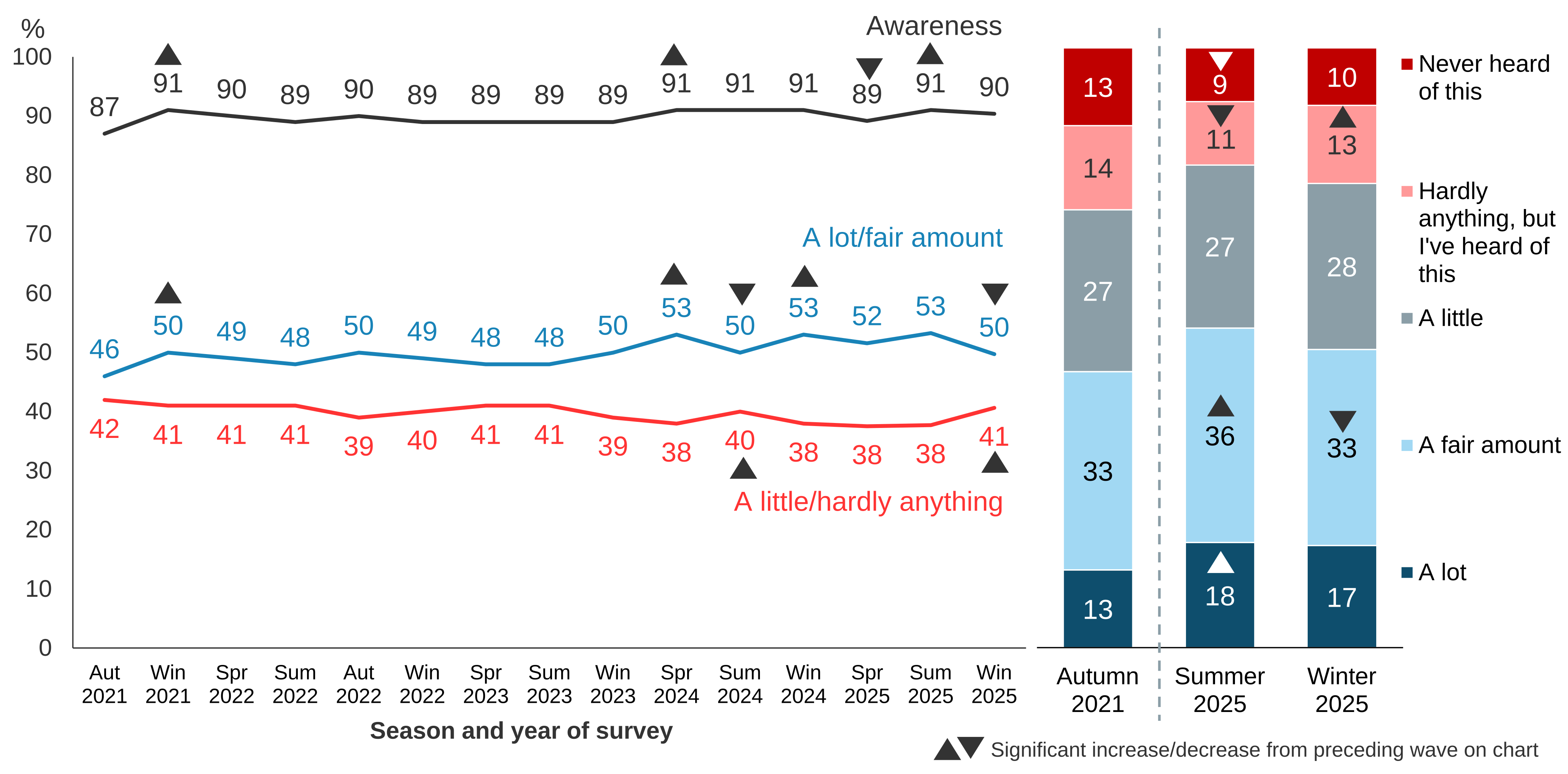 NZKNOW. The UK government is aiming to reduce UK greenhouse gas emissions to ‘Net Zero’ by 2050. This will involve significantly reducing emissions produced by our industries, transport, food, and homes. Any remaining emissions will be balanced by actions that reduce greenhouse gases already in the atmosphere, such as planting trees. Before today, how much, if anything, did you know about the concept of ‘Net Zero’? Base: All wave respondents – Autumn 2021 (5,558), Winter 2021 (3,705), Spring 2022 (4,374), Summer 2022 (4,489), Autumn 2022 (4,158), Winter 2022 (3,572), Spring 2023 (4,405), Summer 2023 (3,998), Winter 2023 (3,741), Spring 2024 (4,085), Summer 2024 (3,640), Winter 2024 (3,214), Spring 2025 (3,411), Summer 2025 (3,526), Winter 2025 (3,282) (Asked each wave). Note: On the line chart, arrows denote a significant difference between one wave and the next. For the bar chart, significant differences are noted between Autumn 2021 and Summer 2025, and between Summer 2025 and Winter 2025. Analysis by subgroups Self-reported knowledge of Net Zero (the percentage who said they knew a lot or a fair amount) followed a similar trend, and was higher among the following subgroups: * People in age groups 55 and over: 55% in both age groups, compared with 39% of those aged 16 to 24. * People with a degree: 68% compared with 45% of those with another kind of qualification and 28% of those with no qualifications. * People living in the South West (59%), Scotland (58%), and the South East (55%); in contrast, the lowest levels were reported in the West Midlands (37%), the East Midlands (41%) and the North East (44%). ## Concern about climate change In Winter 2025, 77% said they were concerned overall about climate change, down slightly from 79% in Summer 2025 (Figure 1.2). A third said they were very concerned (33%), down from 37% in Summer 2025. Over time, aside from some minor fluctuations, overall concern has steadily declined from 85% in Autumn 2021 to 77% in Winter 2025. The proportion who were very concerned has in general followed a similar pattern, falling from 44% to 33% over the period of tracking, with a sharper decrease since the most recent wave. Figure 1.2: Concern about climate change (% based on all people), Autumn 2021 to Winter 2025 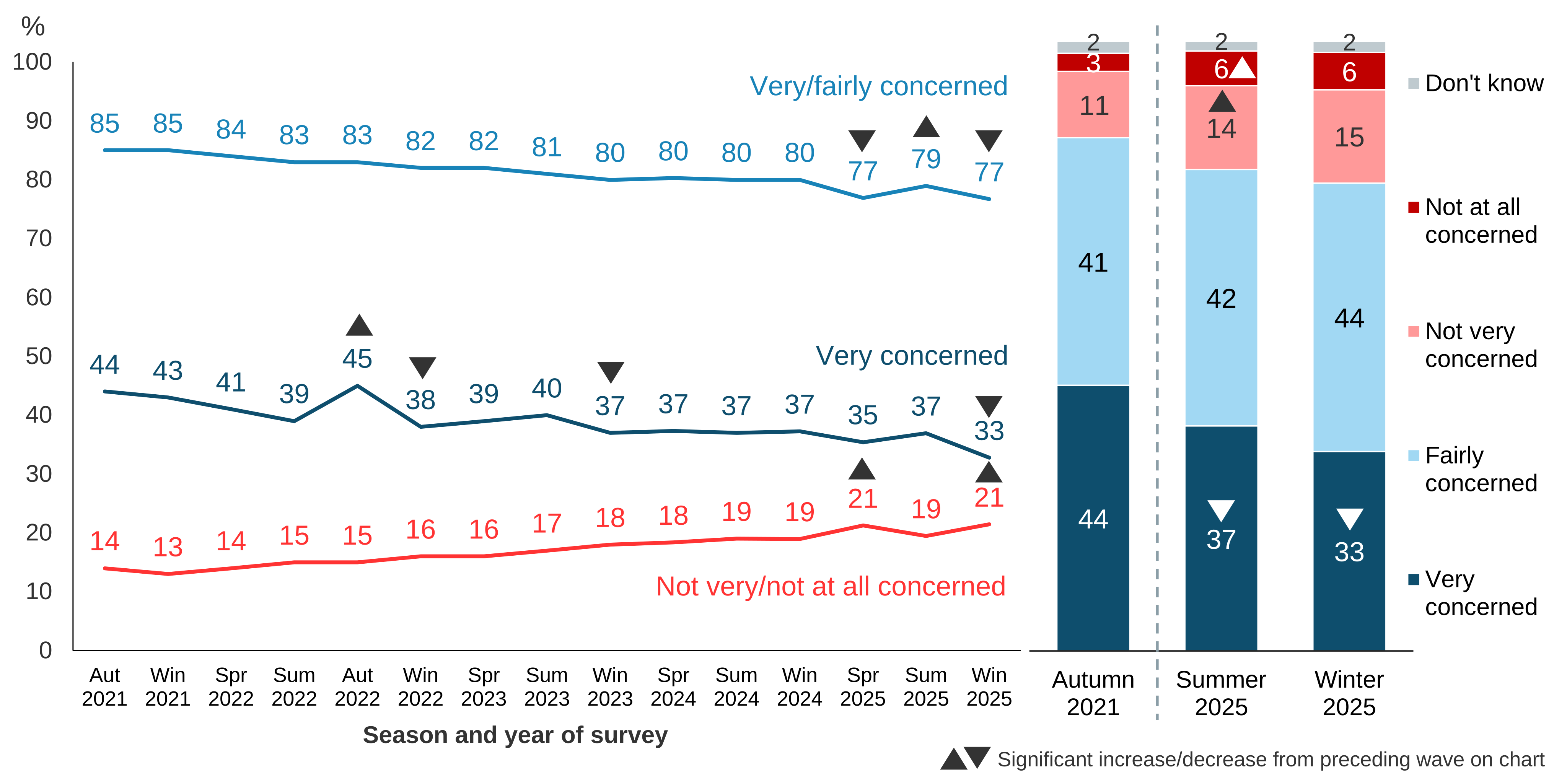 CLIMCONCERN. How concerned, if at all, are you about climate change, sometimes referred to as ‘global warming’? Base: All wave respondents – Autumn 2021 (5,557), Winter 2021 (3,701), Spring 2022 (4,375), Summer 2022 (4,490), Autumn 2022 (4,158), Winter 2022 (3,571), Spring 2023 (4,405), Summer 2023 (3,998), Winter 2023 (3,739), Spring 2024 (4,086), Summer 2024 (3,644), Winter 2024 (3,213), Spring 2025 (3,408), Summer 2025 (3,531) Winter 2025 (3,281) (Asked each wave). Note: On the line chart, arrows denote a significant difference between one wave and the next. For the bar chart, significant differences are noted between Autumn 2021 and Summer 2025, and between Summer 2025 and Winter 2025. Analysis by subgroups[[footnote 1]](#fn:1) The proportion reporting that they were very concerned about climate change was higher among the following subgroups: * People with a degree: 45% compared with those with another kind of qualification, and those with no qualifications (both 27%). * People living in London (40%), the South West (37%) and the East of England and Northern Ireland (both 36%); in contrast people living in West Midlands and Scotland (both 24%) were least likely to be very concerned. People were most likely to say that they were not very or not at all concerned about climate change in the North East and the West Midlands (both 27%) and in Scotland and Northern Ireland (both 25%); in contrast people in London (16%) were least likely to report a lack of concern. Consistently over time, climate change concern has been higher for women than men. However, over time concern has fallen more for men than women leading to an increased gender gap. For example, when the time series started in Autumn 2021, 87% of women and 82% of men were concerned about climate change (a 5-percentage point difference), while in Winter 2025, 81% of women and 73% of men said they were concerned (an 8-percentage point difference); this is similar to the gender gap observed in the previous two waves. ## Information on tackling climate change ### Sources of information In Winter 2025, based on a list presented to respondents[[footnote 2]](#fn:2), TV news (including associated websites) remained the most reported source of climate change information (54%), although this had decreased from 60% in Winter 2024 (Figure 1.3). Around 30%-40% of people reported getting information on climate change from social media (41%), newspapers or their websites (36%), TV/radio documentaries and podcasts (34%, down from 39% in Winter 2024) and friends, family and work colleagues (32%). Other sources were mentioned by at least two in ten included government websites (27%, down from 29% in Winter 2024), online searches (27%, down from 31%), and energy suppliers (22%). Figure 1.3: Sources of information on actions people can take to tackle climate change (% based on all people), Winter 2023 to 2025 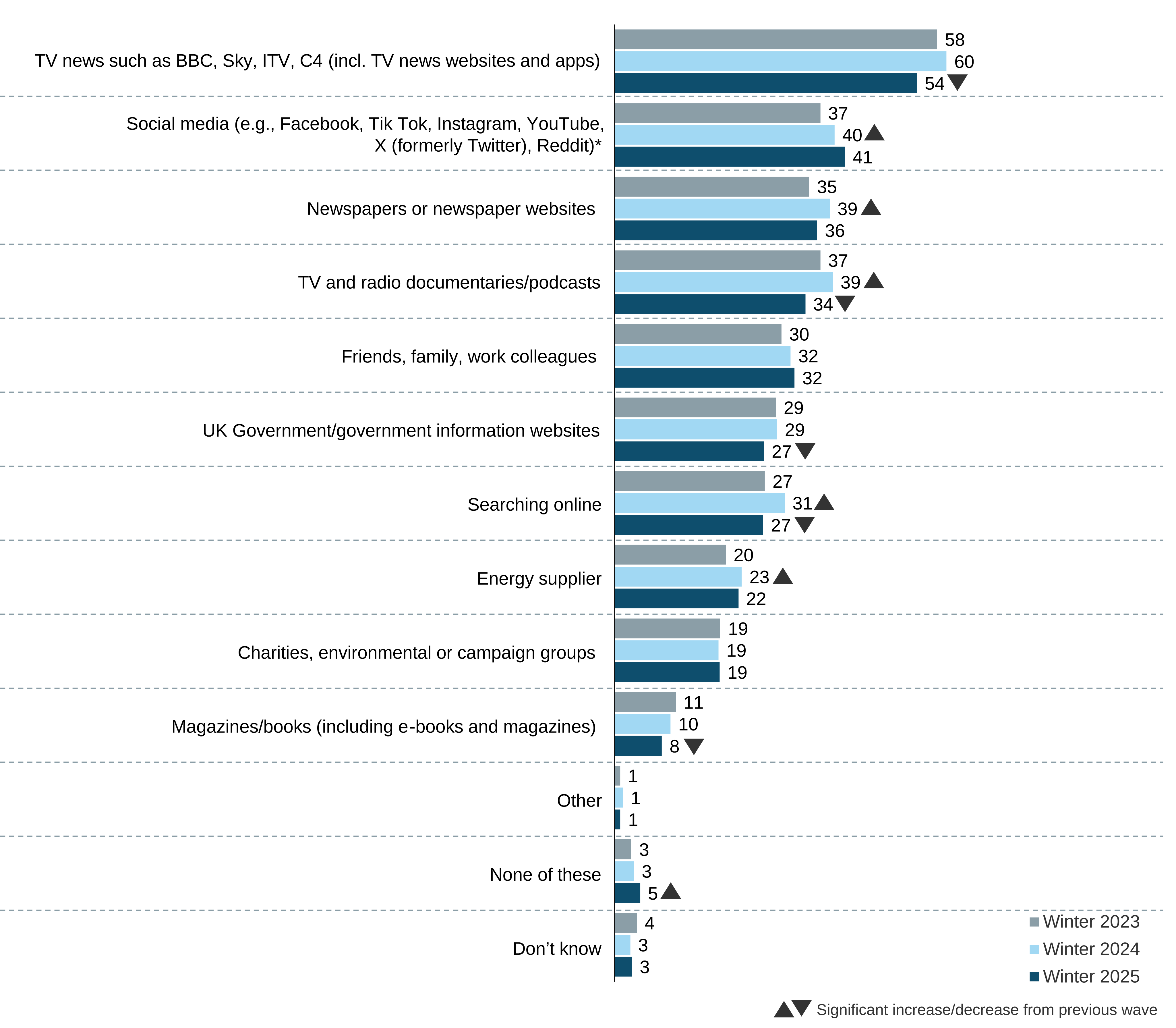 CCHEARD. Looking at the following sources, from which, if any, of these do you hear or read about actions you can take to tackle climate change? This might include making choices about travel, product purchases, or how to save energy at home. \*change to social media examples in Winter 2024 Base: All wave respondents – Winter 2023 (3,732), Winter 2024 (3,214), Winter 2025 (3,277). Analysis by subgroups By age: * Mainstream media sources such as TV, radio and newspapers were more likely to be chosen as a source of climate change information by older people compared with younger people. For example: between 38% and 44% of people aged 55 and over used newspapers or their websites, compared with between 28% and 31% of those in age groups from 16 to 34. * Older people aged 65 or over were less likely than all other age groups to search online: (19% compared with between 27% and 33%) and to get information from friends and family (25% compared with between 31% and 37%). * Younger people were much more likely than older people to get information from social media (from 69% of those aged 16 to 24, declining to 15% of those aged 65 and over). By education: * People with a degree were more likely than those without any qualifications to access information about climate change from all sources, except for TV news. * This difference was particularly notable for searching online (35% of those with a degree vs 12% of those with no qualifications), government websites (35% vs 17%) and charities, environmental and campaign groups (29% vs 6%). By self-reported knowledge about Net Zero: * People who said they knew a lot or a fair amount about Net Zero were more likely than those who had no awareness to select all sources of information except for social media. * This difference was most notable for charities, environmental or campaign groups (27% of those who knew at least a fair amount about Net Zero vs 6% of those unaware); searching online (35% vs 9%); newspapers (44% vs 16%); and TV and radio documentaries and podcasts (43% vs 18%). ### Information needs In Winter 2025, when presented with a list of topics relating to actions to tackle climate change, 67% of people said they would like more information on at least one of these topics, down slightly from 69% in Winter 2024. One in four (26%, no change) were not interested in finding out more information about any of these (Figure 1.4). People remained most likely to want information on how to reduce energy consumption at home (47%), choosing products with less impact on the environment (37%, down from 43%), green financial products (24%, down from 27%), and low impact travel choices (14%, down from 16%). Figure 1.4: Topics relating to actions to reduce climate change that people would like more information about (% based on all people), Winter 2023 to 2025 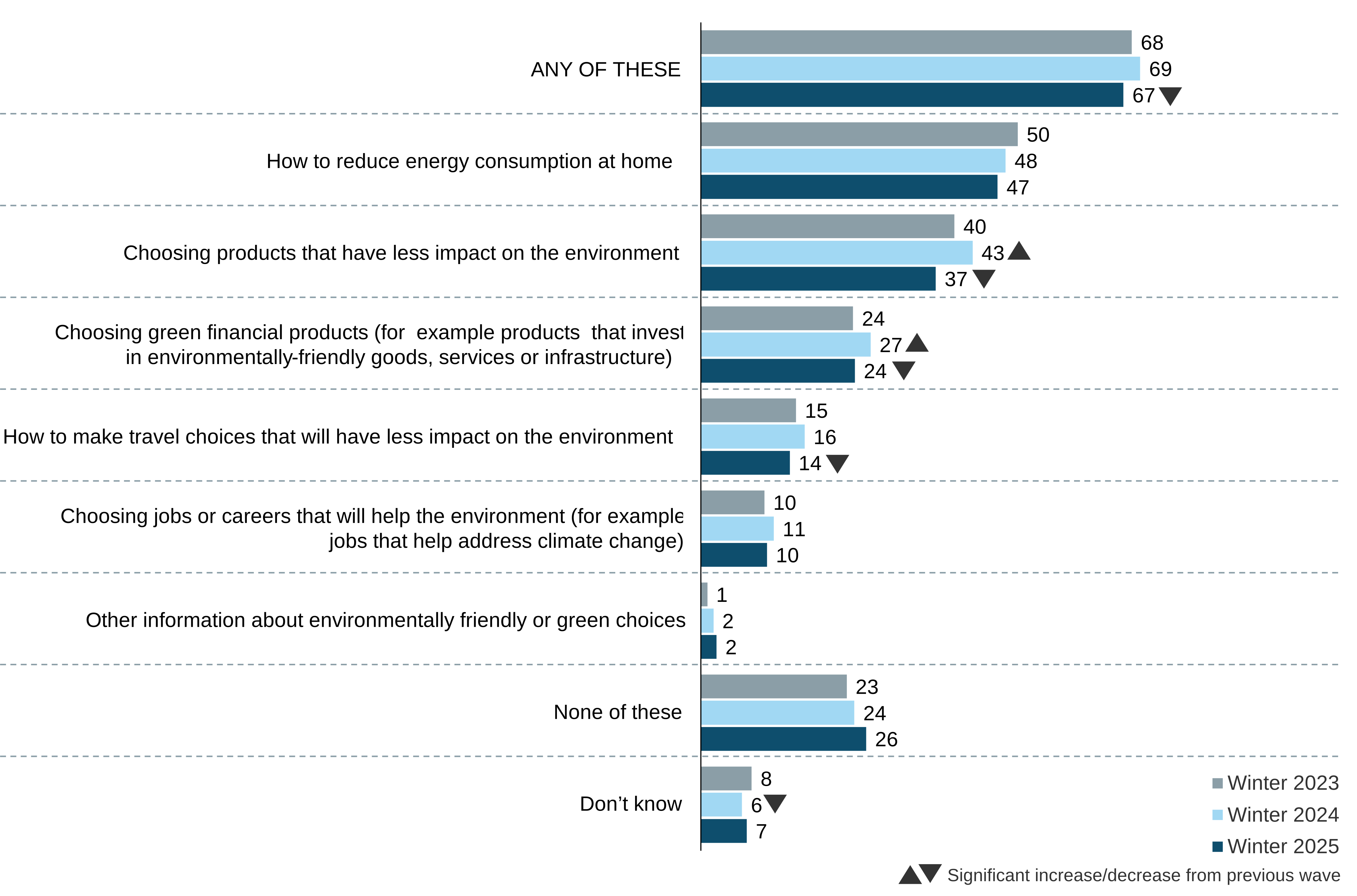 CCINFO. Which, if any, of the following would you like to have more information on? Please select any that apply. Base: All wave respondents – Winter 2023 (3,724), Winter 2024 (3,208), Winter 2025 (3,274). Analysis by subgroups By age: * Younger people aged 16 to 24 were more likely than older people to mention information needs on low impact travel choices (20% vs 12% of those aged 65 and over). Conversely, this age group was less likely to want information on how to reduce energy consumption at home (38%) compared with those in age groups 35 to 54 (between 52% and 53%). * People in age groups 55-64 and 65 and over were more likely to not identify any information needs (both 31%) compared with those in age groups from 16 to 44 (between 19% and 24%). By education: * People with a degree were more likely than those with no qualifications to want to know more about all topics, except how to reduce energy consumption at home (no difference). For example, 33% of degree-educated people wanted more information on green financial products vs 16% with no qualifications. By geography: * People living in London were most likely to report interest in all topics, except for choosing careers that will help the environment. * Interest in how to reduce energy consumption at home was reported most in both London (55%) and Northern Ireland (53%), compared with 47% overall. By self-reported knowledge about Net Zero: * Those who said they knew at least a fair amount about Net Zero were more likely than those saying they knew nothing at all to express interest in: choosing products with less impact on the environment (41% vs 18%), choosing green financial products (29% vs 15%), and low impact travel choices (15% vs 10%). ## Attitudes to action on climate change ### Responsibility for action A new question was added in Winter 2025 to gauge people’s views on responsibility for climate action, and whether this should mostly lie with business, government or the public. On balance, people thought that businesses and industry should have the most responsibility by doing more to reduce their impact (35%), with 31% feeling that responsibility lay mostly with government through introducing more policies to reduce carbon emissions (Figure 1.5). Only 16% thought that the general public should have most responsibility through making lifestyle changes, while 7% did not believe that the UK should be helping to reduce climate change, and 8% were unable to choose an answer. Figure 1.5: Who should have most responsibility for helping to reduce climate change in the UK (% based on all people), Winter 2025 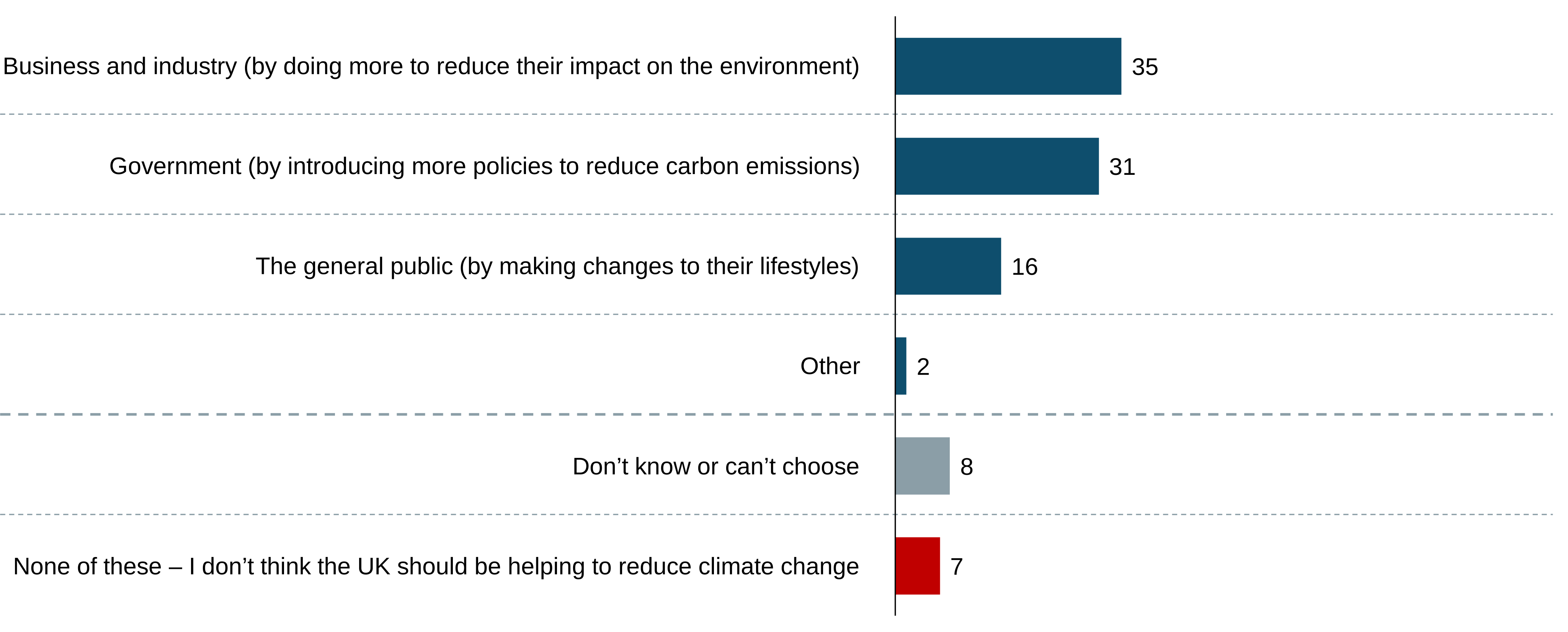 CCRESPONSIBILITY. Which one of these do you think should have the MOST responsibility for helping to reduce climate change in the UK? Base: All wave respondents – Winter 2025 (3,229). Analysis by subgroups A belief that government should have most responsibility for action on UK climate change was higher among the following subgroups: * People in age groups 25 to 44 (between 36% and 39%) compared with those in age groups 55 and over (between 27% and 28%). * People with a degree (37%) compared with those with another kind of qualification (30%) or no qualification (29%). A belief that the UK should not be responsible for helping to reduce climate change at all was higher among people aged 65 and over (11%) compared with those in age groups 16 to 54 (between 5% and 6%). ### Support for government action In response to a further new question added in Winter 2025, 68% of people said that they supported (slightly or strongly) government action to reduce climate change in the UK, with 45% saying they supported this strongly (Figure 1.6). Overall, 12% said they opposed such action. Figure 1.6: Whether support UK government taking action to reduce climate change in the UK (% based on all people), Winter 2025 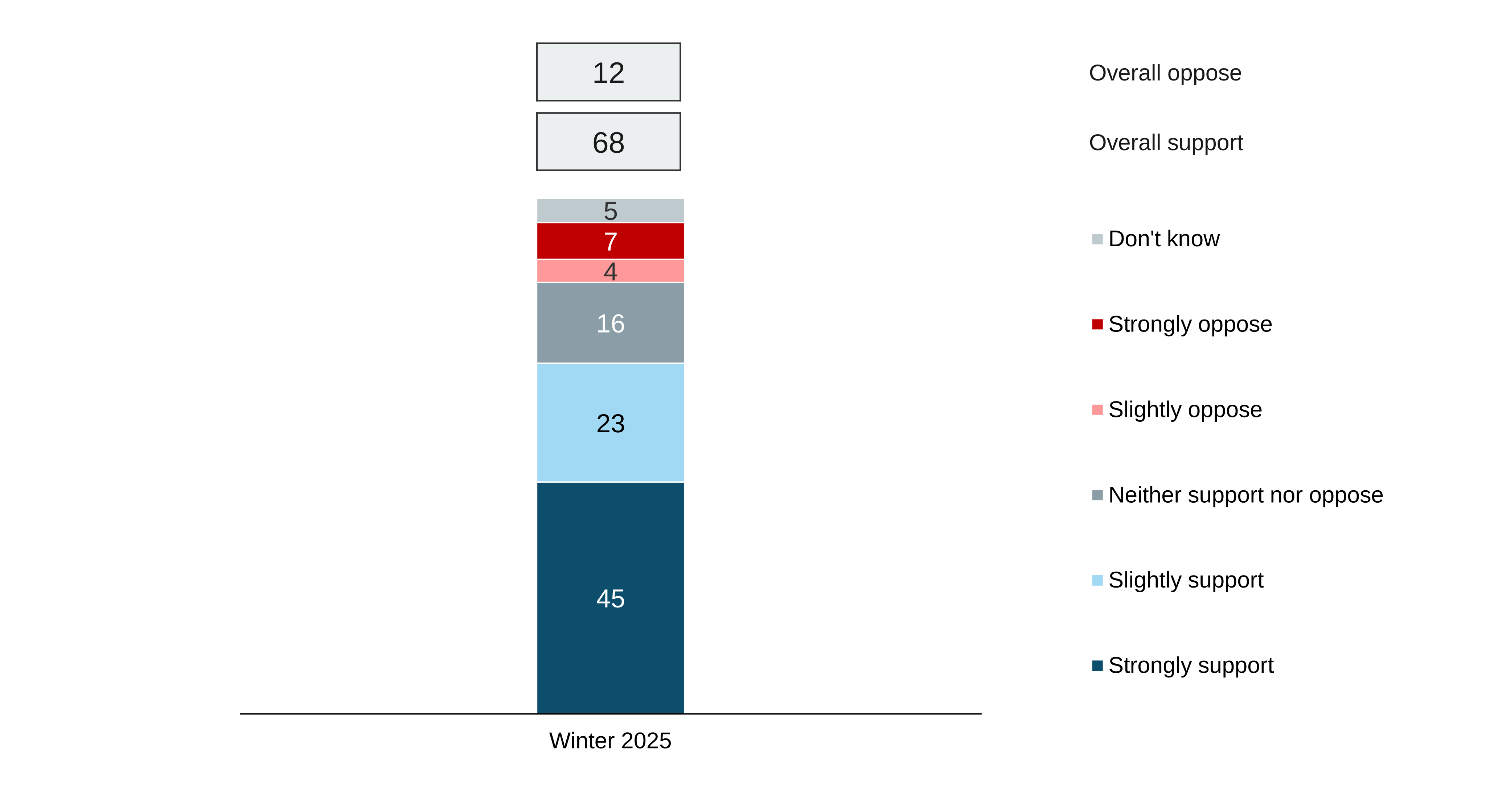 SUPPORTACTION. To what extent do you support or oppose the UK government taking action to reduce climate change in the UK? Base: All wave respondents – Winter 2025 (3,279). Analysis by subgroups Support (strong or slight) for UK government action to reduce UK climate change was higher among the following subgroups: * People in age groups 25 to 54 (between 70% and 72%), compared with those aged 65 and over (64%). * People with a degree (80%), compared with those with no qualifications (52%). * People who say they knew at least a fair amount about Net Zero (73%) compared with those unaware of Net Zero (46%). ## Climate change leadership Overall, in Winter 2025, 39% of people agreed (strongly or slightly) that the UK is a global leader in tackling climate (Figure 1.7), while 20% disagreed. A substantial proportion did not provide an opinion either way (30%). Attitudes on this measure have not changed since Winter 2024. When asked how important it is that the UK is a global leader in tackling climate change, 65% said that it was important (very or fairly), down from 69% in Winter 2024. This decline was driven by a decrease in the proportion saying this was very important (31%, down from 34%). Conversely, there was an increase in the proportion saying this was not very or not at all important (26%, up from 23%). Figure 1.7: Attitudes towards the UK as a global leader on tackling climate change (% based on all people), Winter 2024 to 2025 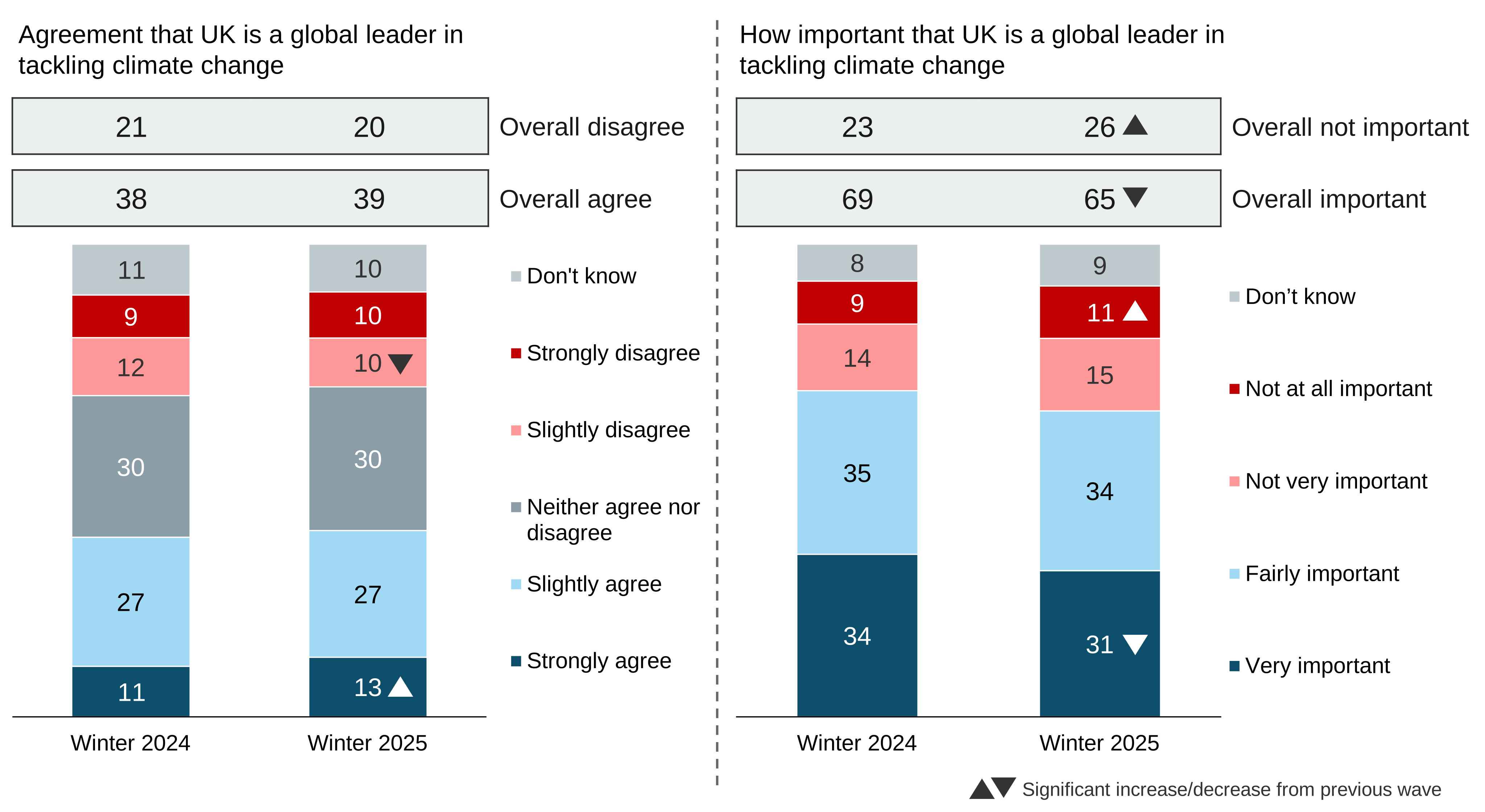 ICFKNOW. How much do you agree or disagree that the UK is a global leader in tackling climate change? ICFIMPORT. How important or unimportant do you feel it is that the UK is a global leader on tackling climate change? Base: All wave respondents: Agreement/Importance – Winter 2024 (3,212/3,212), Winter 2025 (3,278/3,276). Analysis by subgroups Agreement (strong or slight) that the UK is a global leader in tackling climate change was higher among the following subgroups: * People in age groups 45 and over: between 39% and 45% compared with 30% of those aged 16 to 24. * People with a degree: 44% compared with 39% of those with another kind of qualification and 37% of those with no qualifications. * Those living in the North East (46%) and London (44%); in contrast those living in Northern Ireland (33%) and the West Midlands (34%) were less likely to agree. Perceived importance (very or fairly important) of the UK being a global leader in tackling climate change was higher among the following subgroups: * Those with a degree: 71% compared with 56% of those with no qualifications. * Those living in London (73%). In contrast those living in the West Midlands (54%) and the North East (58%) were less likely to think it was important. Older people were more likely than younger people to think UK global leadership was not important (33% of those aged 65 and over declining to 16% of those aged 16 to 24). ## Further findings on Net Zero and climate change In previous waves, questions were included on other topics relating to Net Zero and climate change. The latest findings relating to these topics can be found as follows: * Attitudes towards Net Zero, see Summer 2025 report on Net Zero and climate change - section on ‘[Attitudes towards Net Zero](https://www.gov.uk/government/statistics/desnz-public-attitudes-tracker-summer-2025/desnz-public-attitudes-tracker-net-zero-and-climate-change-summer-2025-uk#attitudes-towards-net-zero:~:text=Northern%20Ireland%20(43%25))’ * Attitudes towards climate change, see Summer 2025 report on Net Zero and climate change - section on ‘[Attitudes towards climate change](https://www.gov.uk/government/statistics/desnz-public-attitudes-tracker-summer-2025/desnz-public-attitudes-tracker-net-zero-and-climate-change-summer-2025-uk#attitudes-towards-climate-change:~:text=percentage%20point%20difference)’ * Self-reported behaviours that could help to tackle climate change, see Summer 2025 report on Net Zero and climate change - section on ‘[Behaviours to tackle climate change](https://www.gov.uk/government/statistics/desnz-public-attitudes-tracker-summer-2025/desnz-public-attitudes-tracker-net-zero-and-climate-change-summer-2025-uk#attitudes-towards-climate-change:~:text=and%20Scotland%20(59%25))’ * Which behaviours are thought to have the biggest impact on tackling climate change, see Summer 2025 report on Net Zero and climate change - section on ‘[Behaviours thought to have the biggest impact on tackling climate change](https://www.gov.uk/government/statistics/desnz-public-attitudes-tracker-summer-2025/desnz-public-attitudes-tracker-net-zero-and-climate-change-summer-2025-uk#attitudes-towards-climate-change:~:text=about%20climate%20change.-,Behaviours%20thought%20to%20have%20the%20biggest%20impact%20on%20tackling%20climate%20change,-Respondents%20were%20presented)’ * Level of trust in information sources on climate change, see Summer 2025 report on Net Zero and climate change - section on ‘[Information on tackling climate change](https://www.gov.uk/government/statistics/desnz-public-attitudes-tracker-summer-2025/desnz-public-attitudes-tracker-net-zero-and-climate-change-summer-2025-uk#attitudes-towards-climate-change:~:text=compared%20with%205%25)’ 1. Age is not included in the subgroup analysis as no clear differences were reported. [↩](#fnref:1) 2. The list was slightly amended in Winter 2024, with the examples of social media given expanded to include YouTube. [↩](#fnref:2) --- The DESNZ Public Attitudes Tracker is a nationally representative annual survey of adults (aged 16+) in the UK that tracks public awareness, attitudes and behaviours relating to the policies of the Department for Energy Security and Net Zero (DESNZ), such as energy and climate change. This report provides a summary of the headline findings relating to renewable energy from the Winter 2025 wave of the Tracker, which ran from 4 November to 9 December 2025. Notes for interpretation of findings Differences between groups are only reported where they are statistically significant at the 95% confidence interval level. The annual personal income referred to in the report is a self-reported measure. Line charts included in this report, based on a longer time series, use abbreviated season names in the x-axis (e.g. Winter 2025 = Win 2025). The age-related findings are reported using six age groups (16-24, 25-34, 35-44, 45-54, 55-64, 65 and over). In some cases, findings across age groups have been combined to describe a general trend, for example, ‘between 78% and 88% of people aged 45 and above’ refers to the range of percentages for the three age groups 45-54, 55-64 and 65+. Please note that some of the geographical findings have fluctuated over time. These variations may, in part, be due to the base sizes in specific areas and the wide geographic area covered by regions. Two summary self-reported measures are used in this report: * ‘Awareness’ encompasses all respondents who said they had heard of a particular concept or technology, including those who said they know ‘hardly anything but I’ve heard of this’, ‘a little’, ‘a fair amount’ or ‘a lot’. * ‘Knowledge’ encompasses those who said that they know ‘a fair amount’ or ‘a lot’ about a topic. ## Support for renewable energy Figure 2.1 displays both the longer-term trends in overall support for renewable energy (line chart), and the detailed data on support for the most recent two waves alongside the baseline (bar chart). In Winter 2025, overall support for the use of renewable energy such as wind power, solar energy and biomass to provide electricity, fuel and heat was around eight in ten (78%), with opposition at 5%, both unchanged since Summer 2025 (no significant change). Overall support has declined over time from 87% in Autumn 2021. In particular, strong support for renewable energy has declined from 54% in Autumn 2021 to 44% in Winter 2025. Figure 2.1: Whether support use of renewable energy (% based on all people), Autumn 2021 to Winter 2025 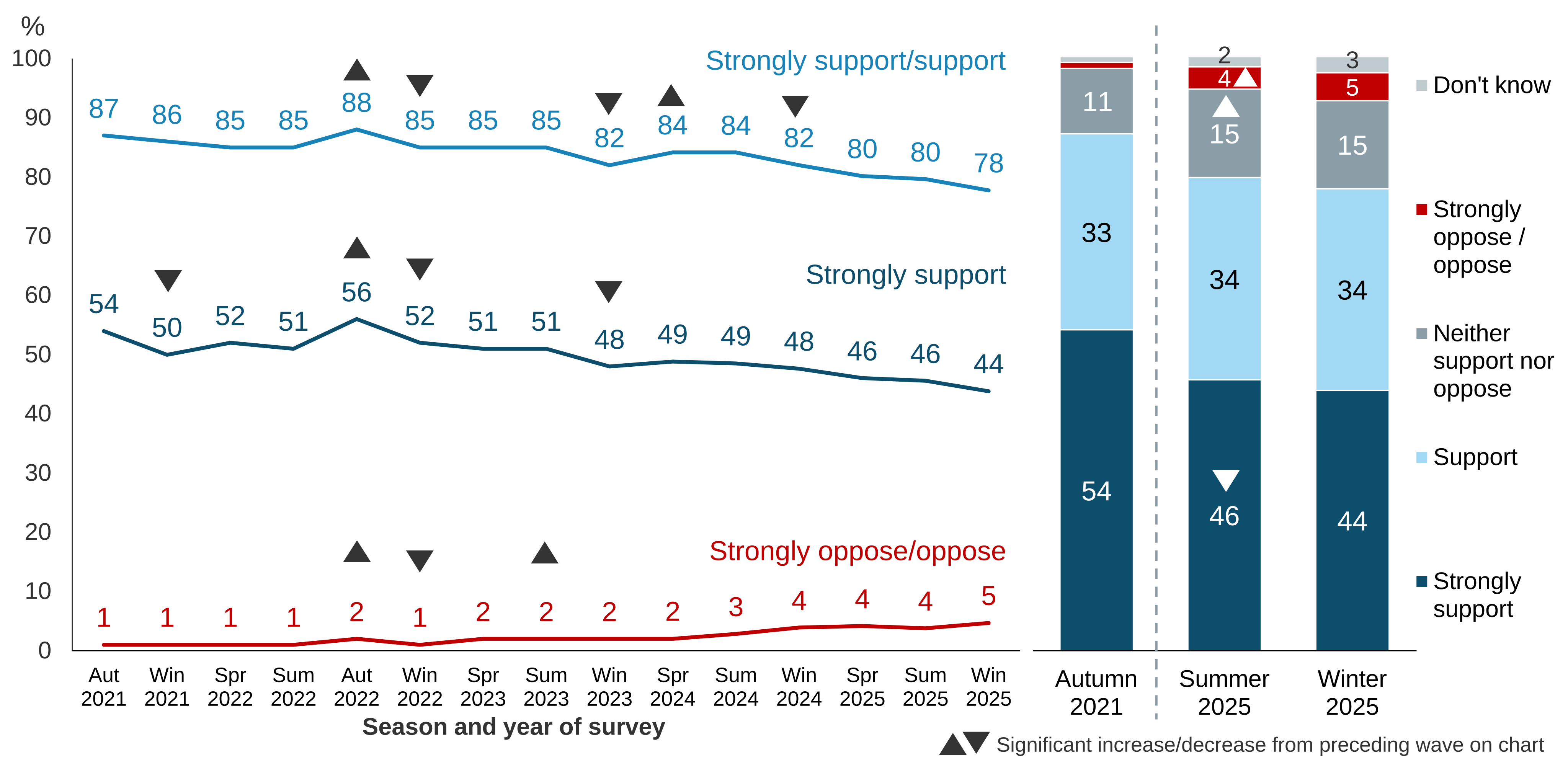 RENEWSUPPORT. The next question is about renewable energy. This includes a number of different forms of energy, such as wind power, solar energy and biomass. Do you support or oppose the use of renewable energy for providing our electricity, fuel and heat? Base: All wave respondents – Autumn 2021 (5,556), Winter 2021 (3,705), Spring 2022 (4,373), Summer 2022 (4,489), Autumn 2022 (4,160), Winter 2022 (3,572), Spring 2023 (4,403), Summer 2023 (3,997), Winter 2023 (3,724), Spring 2024 (4,087), Summer 2024 (3,642), Winter 2024 (3,212), Spring 2025 (3,412), Summer 2025 (3,529), Winter 2025 (3,283) (Asked each wave). Note: On the line chart, arrows denote a significant difference between one wave and the next. For the bar chart, significant differences are noted between Autumn 2021 and Summer 2025, and between Summer 2025 and Winter 2025. Analysis by subgroups There was relatively little variation by demographic or other subgroups. * Overall support for renewables was highest among people living in London (84%), and in the South West (83%); in contrast it was lowest in the West Midlands (67%). * Levels of strong support were highest in London (54% vs 44% overall). ## Great British Energy A question has been asked each wave since Winter 2024 about Great British Energy (GBE), a government initiative set out in 2024. Respondents are provided with a brief description as follows: ‘The UK government has set up a publicly owned, clean energy company, called Great British Energy. Great British Energy will operate in all four nations of the UK’. In Winter 2025, awareness remained stable at 57% (Figure 2.2). However, levels of knowledge (knowing a lot or a fair amount) decreased slightly between Summer 2025 and Winter 2025 from 13% to 11%. A quarter (25%) said they knew a little about GBE, while 22% said they knew hardly anything. Figure 2.2: Awareness of Great British Energy (% based on all people), Winter 2024 to Winter 2025 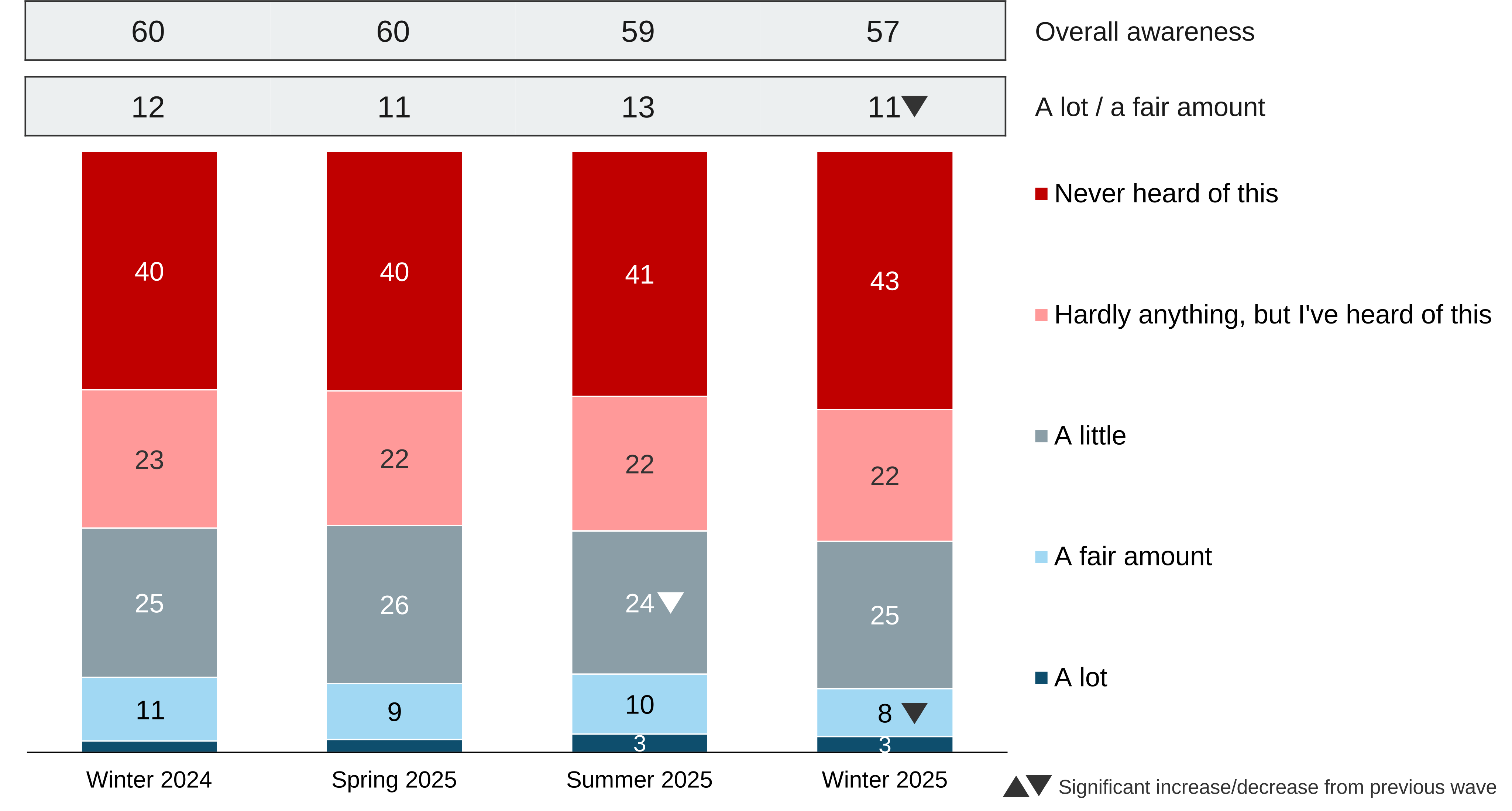 GBEKNOW. Before today, how much, if anything, did you know about Great British Energy? Base: All wave respondents – Winter 2024 (3,212), Spring 2025 (3,409), Summer 2025 (3,530), Winter 2025 (3,281). Analysis by subgroups Overall awareness and knowledge of GBE was higher among the following subgroups: * Awareness was higher for those in age groups 16 to 34 (between 60% and 61%) and those aged 65 and over (62%), compared with between 49% and 51% of those in age groups 35 to 54. * Self-reported knowledge (knowing a lot or a fair amount) about GBE was higher among people with a degree: 13% compared with 8% of those with no qualifications. ## Clean Power 2030 A question has been asked in each wave since Spring 2025 about the government’s new clean power goal. Respondents are provided with a brief description as follows: ‘One of the government’s goals is to achieve Clean Power by 2030. This means generating at least 95% of electricity in Great Britain from clean sources, like wind and solar, by 2030’. A majority (83%) were aware of Clean Power 2030, unchanged since Spring and Summer 2025. Three in ten (30%, down slightly from 33% in Summer 2025) said they knew a lot or a fair amount about this (Figure 2.3). Figure 2.3: Awareness of Clean Power 2030 (% based on all people), Spring 2025 to Winter 2025 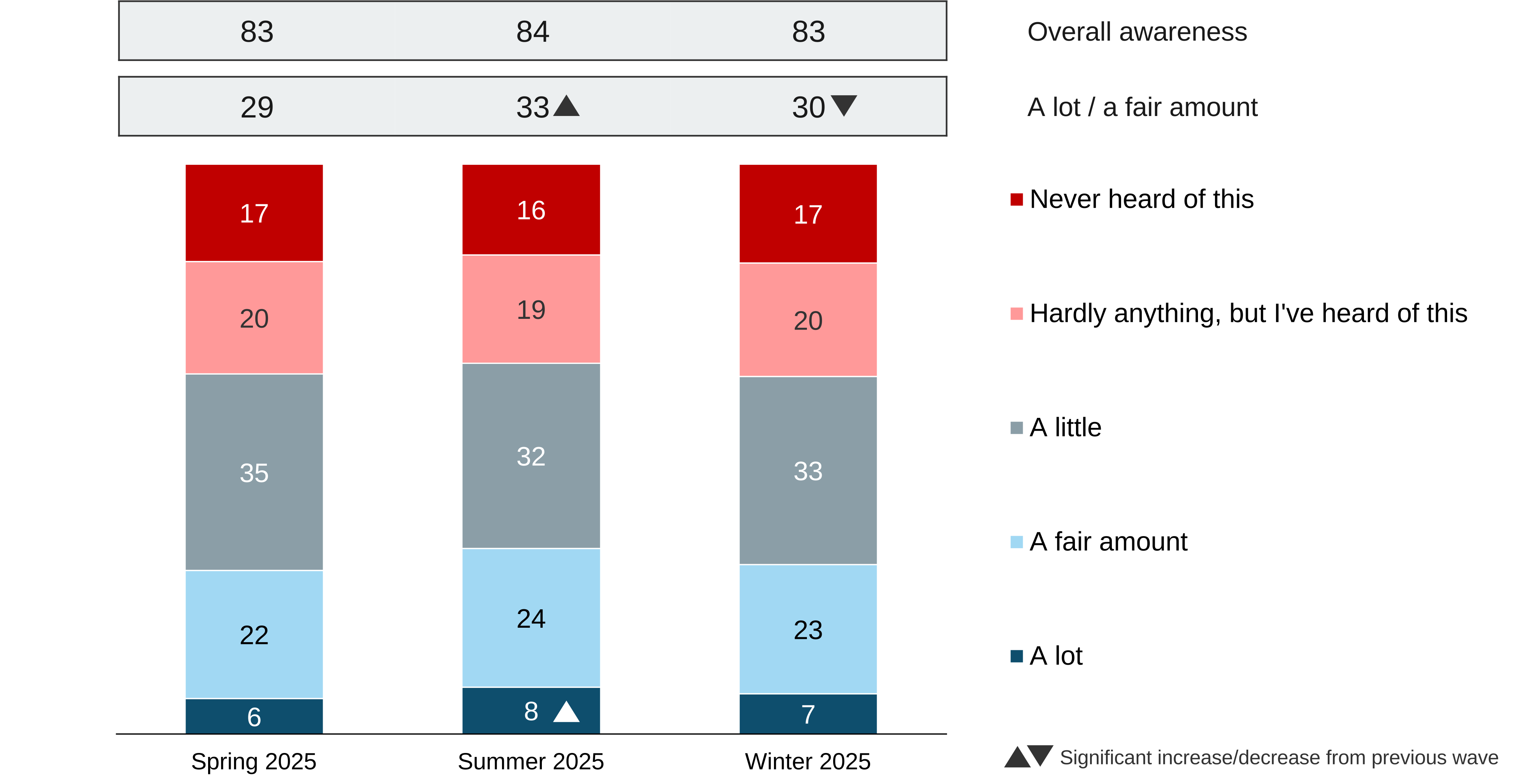 CLEANPOWER2030. Before today, how much, if anything, did you know about this? Base: All wave respondents – Spring 2025 (3,411), Summer 2025 (3,530), Winter 2025 (3,281). Analysis by subgroups Overall awareness of Clean Power 2030 was higher among the following subgroups: * People aged 65 and over (92%) compared with those in age groups under 65 (between 73% and 87%); awareness was lowest for those aged 16 to 24 (73%). * People with a degree: 86% compared with 79% of those with no qualifications. ## Further findings on Renewable energy * Support for specific types of renewable energy, see Spring 2025 report on Renewable Energy - section on ‘[Support for different types of renewables](https://www.gov.uk/government/statistics/desnz-public-attitudes-tracker-spring-2025/desnz-public-attitudes-tracker-renewable-energy-spring-2025-uk#:~:text=Northern%20Ireland%20(4%25))’ * Attitudes towards renewable energy, see Spring 2025 report on Renewable Energy - section on ‘[Attitudes towards renewable energy](https://www.gov.uk/government/statistics/desnz-public-attitudes-tracker-spring-2025/desnz-public-attitudes-tracker-renewable-energy-spring-2025-uk#attitudes-towards-renewable-energy:~:text=up%20from%2021%25)’ * Potential benefits that would make people more likely to support the construction of renewable energy infrastructure in their local area, see Summer 2025 report on Renewable Energy - section on ‘[Benefits of renewable energy infrastructure](https://www.gov.uk/government/statistics/desnz-public-attitudes-tracker-summer-2025/desnz-public-attitudes-tracker-renewable-energy-summer-2025-uk#benefits-of-renewable-energy-infrastructure:~:text=urban%20areas%20(12%25))’ * Attitudes towards the construction of windfarms and solar panels in their local area, see Summer 2025 report on [Renewable Energy](https://www.gov.uk/government/statistics/desnz-public-attitudes-tracker-summer-2025/desnz-public-attitudes-tracker-renewable-energy-summer-2025-uk#attitudes-towards-local-wind-farms:~:text=DESNZ%20Public%20Attitudes%20Tracker%3A%20Renewable%20energy%2C%20Summer%202025%2C%20UK) * Attitudes towards the construction of windfarms and solar panels in their local area and reasons for these attitudes, see Spring 2025 report on [Renewable Energy](https://www.gov.uk/government/statistics/desnz-public-attitudes-tracker-spring-2025/desnz-public-attitudes-tracker-renewable-energy-spring-2025-uk#attitudes-towards-renewable-energy:~:text=DESNZ%20Public%20Attitudes%20Tracker%3A%20Renewable%20energy%2C%20Spring%202025%2C%20UK) --- The DESNZ Public Attitudes Tracker is a nationally representative annual survey of adults (aged 16+) in the UK that tracks public awareness, attitudes and behaviours relating to the policies of the Department for Energy Security and Net Zero (DESNZ), such as energy and climate change. This report provides a summary of the headline findings relating to energy infrastructure and energy security from the Winter 2025 wave of the Tracker, which ran from 4 November to 9 December 2025. Notes for interpretation of findings Differences between groups are only reported where they are statistically significant at the 95% confidence interval level. The annual personal income referred to in the report is a self-reported measure. Line charts included in this report, based on a longer time series, use abbreviated season names in the x-axis (e.g. Winter 2025 = Win 2025). The age-related findings are reported using six age groups (16-24, 25-34, 35-44, 45-54, 55-64, 65 and over). In some cases, findings across age groups have been combined to describe a general trend, for example, ‘between 78% and 88% of people aged 45 and above’ refers to the range of percentages for the three age groups 45-54, 55-64 and 65+. Please note that some of the geographical findings have fluctuated over time. These variations may, in part, be due to the base sizes in specific areas and the wide geographic area covered by regions. Two summary self-reported measures are used in this report: * ‘Awareness’ encompasses all respondents who said they had heard of a particular concept or technology, including those who said they know ‘hardly anything but I’ve heard of this’, ‘a little’, ‘a fair amount’ or ‘a lot’. * ‘Knowledge’ encompasses those who said that they know ‘a fair amount’ or ‘a lot’ about a topic. ## Awareness and support for new electricity network infrastructure A question on awareness of the need for new electricity network infrastructure, is asked in Summer and Winter waves[[footnote 1]](#fn:1). Before being presented with the questions, the topic was introduced as follows: ‘As the UK increases the amount of electricity generated from low carbon and renewable sources, more electricity network infrastructure will be required to transfer electricity from where it is generated to where it is needed. This will include pylons, overhead power lines, and substations. Substations are sites which connect the main network to the distribution networks that supply homes and businesses. This includes sites that connect the offshore electricity transmission network onshore.’ Figure 3.1 displays the longer-term trends in overall awareness (had at least heard of it) and knowledge (a lot/fair amount) of new energy infrastructure (line chart). It also displays the detailed awareness and knowledge data for the most recent two waves alongside the baseline (bar chart). While awareness increased between Winter 2024 (75%) and Summer 2025 (81%), this decreased in Winter 2025 (75%). Knowledge also decreased to 22% in Winter 2025 down from 27% in Summer 2025. This follows a pattern where awareness and knowledge have been higher in summer compared to winter waves (Figure 3.1). Figure 3.1: Awareness of the need to build more electricity network infrastructure (% based on all people), Summer 2023 and 2024, Winter 2024, Summer 2025\*, Winter 2025 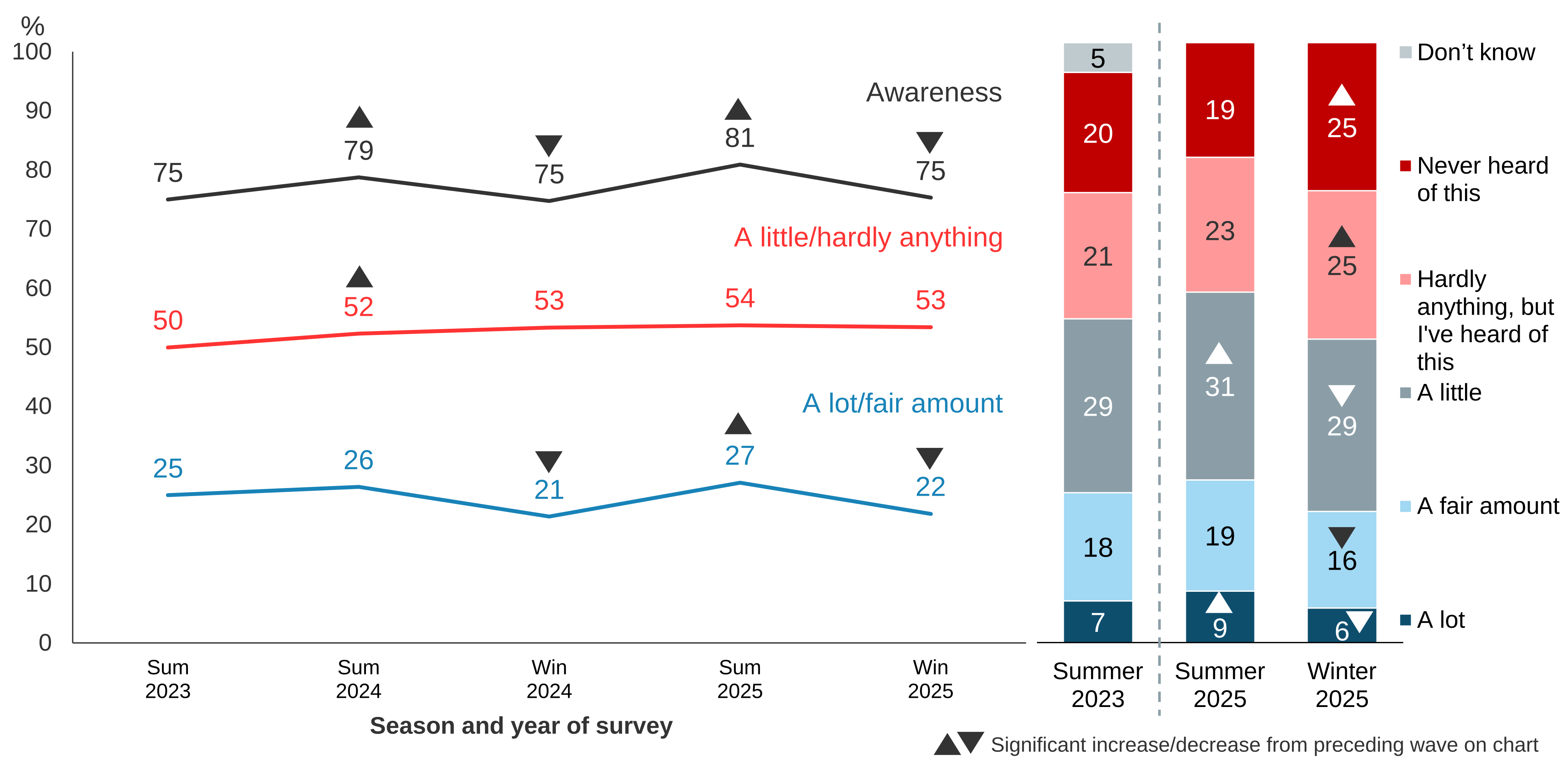 INFRAKNOW. Before today how much, if anything, did you know about the need to build more electricity network infrastructure as part of the UK’s transition to low carbon and renewable energy? \*‘Don’t know’ option not included in answer list from Winter 2024. Base: All wave respondents – Summer 2023 (4,000), Summer 2024 (3,642), Winter 2024 (3,211), Summer 2025 (3,436), Winter 2025 (3,280). \*The findings for Summer 2025 have been rebased to ensure comparability with Winter 2024. See footnote at the start of this section for further details. Note: On the line chart, arrows denote a significant difference between one wave and the next. For the bar chart, significant differences are noted between Summer 2023 and Summer 2025, and between Summer 2025 and Winter 2025. Analysis by subgroups Knowledge about the need to build more energy infrastructure was higher among the following subgroups: * Older people: knowledge (knowing a fair amount or a lot) declined from 27% of those aged 65 and over to 16% of those aged 16 to 24. * People with a degree: 32% compared with 18% of those with another kind of qualification and 13% of those with no qualifications. * People living in Scotland (29%); in contrast the lowest levels were reported in the North East and Northern Ireland (both 16%) and in the West Midlands (17%). A similar pattern of findings was observed in subgroups for overall awareness. ### Information priorities for planned new electricity infrastructure in local area People were asked what information they would find most useful to know about during the planning stage of new electricity network infrastructure. This question was first asked in Winter 2024. Respondents were first asked to imagine that new electricity network infrastructure such as pylons, overhead power lines, and substations was planned for their local area. They were then asked to choose three types of information from a list that they thought would be the most important to know about during the planning stage. In Winter 2025, the most important item of information remained the impact on the cost of electricity bills (48%), followed by impact on local plant and animal life (40% down from 43%), and the visual impact on the landscape (40%) (Figure 3.2). Around three in ten people selected other items including disruption caused by construction (31%), impact on property prices (30% up from 25%) and the purpose of the infrastructure (29%). Benefits to the local community were mentioned by 22% (down from 24%). Figure 3.2: Most important information needs at planning stage of new electricity network infrastructure (% based on all people), Winter 2024 to 2025 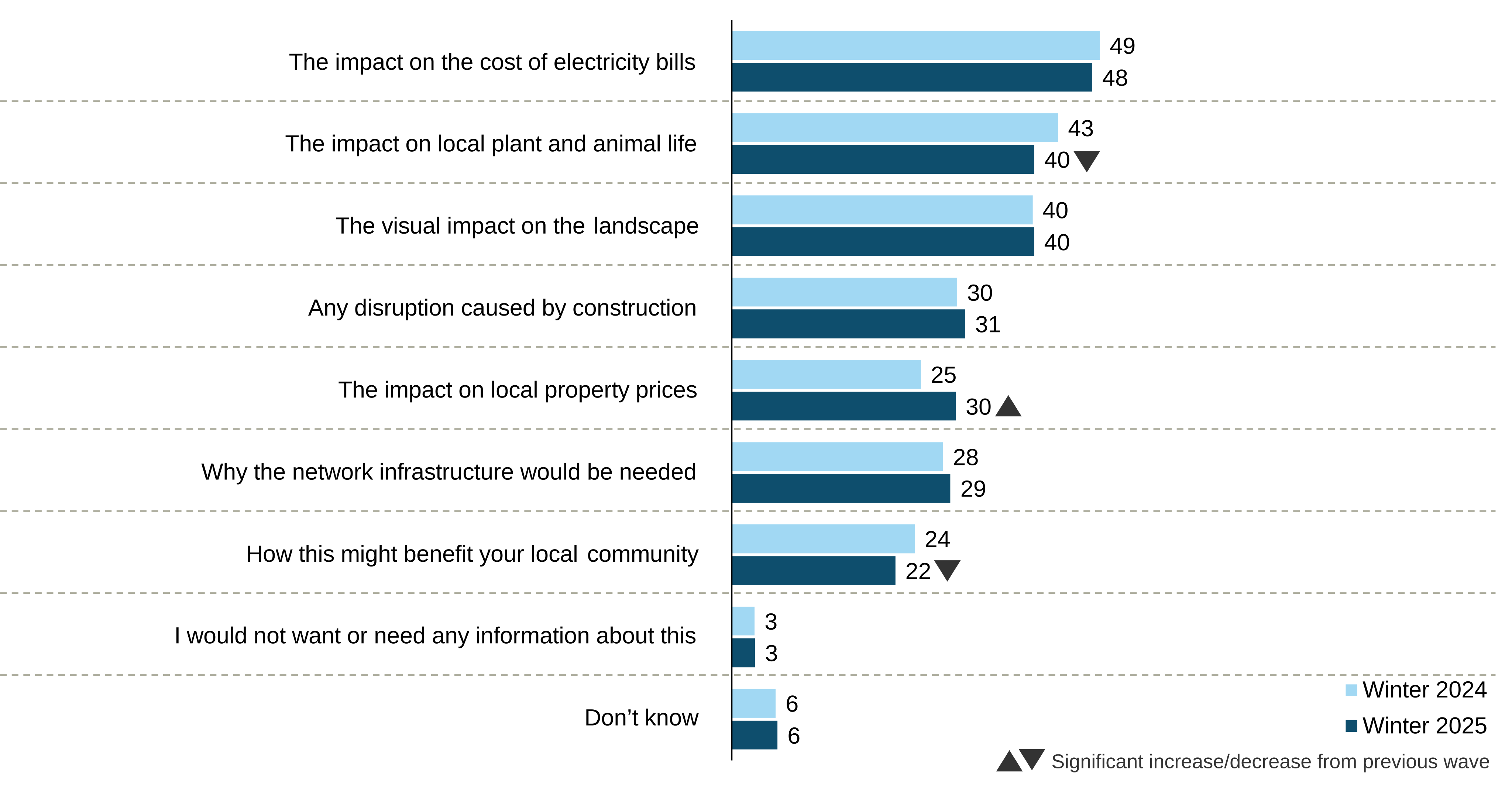 INFRA2IMP. Please now imagine that new electricity network infrastructure such as pylons, overhead power lines, and substations is planned for your local area. What would be the most important information that you would like to know about during the planning stage? Please select up to three responses. Base: All wave respondents – Winter 2024 (3,187), Winter 2025 (3,254). Analysis by subgroups By age: * People aged 55 and over were more likely to prioritise information about the visual impact on the landscape (between 47% and 50%) compared with between 31% and 34% of those in age groups from 16 to 44. * There has been an increase in the perceived importance of the visual impact on the landscape among those aged 16 to 24 (from 22% to 34%). * People aged 65 and over were more likely to prioritise the rationale for the infrastructure (33%) compared with between 25% and 27% of those in age groups from 16 to 44. * People in age groups 16 to 34 were more likely to prioritise information on disruption caused (between 36% and 40%) compared with those in age groups from 55 and over (between 25% and 26%). * Between 24% and 25% in age groups 45 and above were interested in how this might benefit their local community, compared to 15% of people aged 16 to 24. By education: * Those with a degree were more likely than those with no qualifications to prioritise information on the impact on local plant and animal life (46% vs 30%), the visual impact on the landscape (44% vs 34%), impact on property prices (31% vs 24%), and benefits to the local community (28% vs 20%). By geography: * Information on the impact on cost of bills was more important for people in urban areas (50%) than rural areas (39%). * In contrast, the visual impact on the landscape and the impact on local plant and animal life was more important for people in rural areas compared to urban areas (51% vs 37% for visual impact, and 48% vs 38% for local plant and animal life). * People living in London were most likely to prioritise information about disruption caused by construction (39% vs 31% overall), and about the impact on bills (55%); the latter was also higher in the North East (54%), compared with 48% overall. * Residents in the South West were most keen to know about the visual impact on the landscape (50% vs 40% overall). * Residents in Northern Ireland were most focussed on property prices (40% vs 30% overall) while those in the East Midlands were most focussed on benefits to the local community (29% vs 22% overall). ## Nuclear energy Questions on attitudes towards nuclear energy are asked annually in Winter waves. People are first asked whether they agree or disagree with four statements in relation to nuclear energy. Data is shown in Figure 3.3 for the baseline Winter 2021 wave, and for the most recent two waves. In Winter 2025, as in previous years, for each of the four statements the proportion of respondents who gave a non-opinion response (that is ‘neither agree nor disagree’ or ‘don’t know’) was high, ranging between 42% and 53%. Among those who gave an opinion for each statement, people were on balance more positive than negative about nuclear energy. Between Winter 2021 and Winter 2025 there had been an increase in positive attitudes towards nuclear energy, but this has broadly stabilised in the latest two waves. Overall, in Winter 2025: * 51% agreed that ‘nuclear energy provides a reliable source of energy in the UK’; 7% disagreed (down from 9% in Winter 2024). * 45% agreed that ‘nuclear energy will help combat climate change in the UK’; 9% disagreed (down from 12% in Winter 2024). * 36% agreed that ‘nuclear energy offers affordable energy for the UK’; 11% disagreed. * 35% agreed that ‘nuclear energy provides a safe source of energy in the UK’; 19% disagreed (continuing a decline from 25% in Winter 2021 and 21% in Winter 2024). Figure 3.3: Attitudes towards nuclear energy (% based on all people), baseline wave (Winter 2021) and two most recent waves (Winter 2024 & Winter 2025) 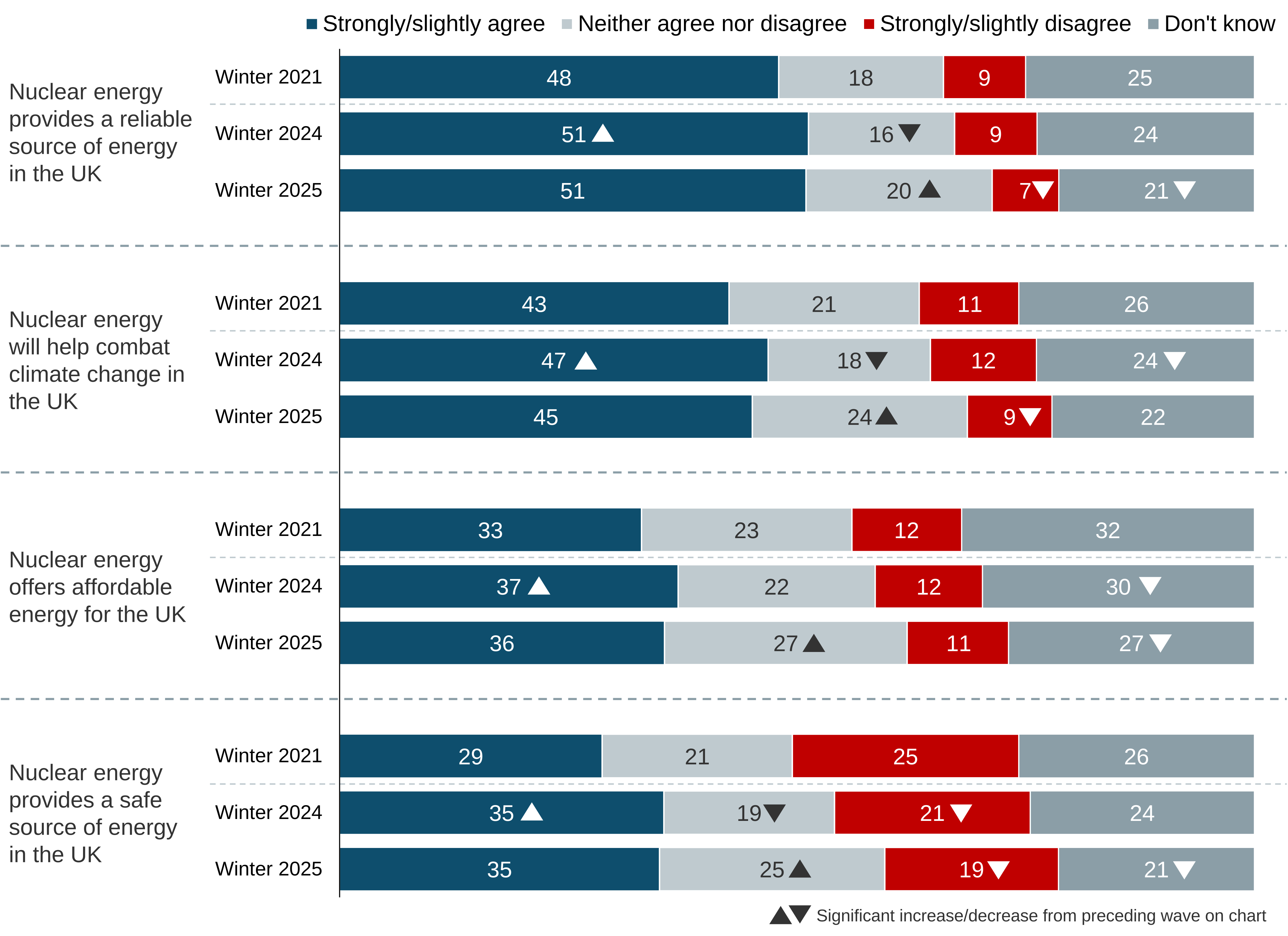 NUCATTA-NUCATTD. The next questions are about nuclear energy. How much do you agree or disagree with the following statements? Base: All wave respondents – Winter 2021 / Winter 2024 / Winter 2025: Nuclear energy provides a reliable source of energy in the UK (3,669/3,204/3,255), Nuclear energy will help combat climate change in the UK (3,683/3,209/3,262), Nuclear energy offers affordable energy for the UK (3,668/3,207/3,251), Nuclear energy provides a safe source of energy in the UK (3,670/3,207/3,247). Analysis by subgroups By age * People in age groups 55 and over (between 53% and 56%) were more likely than those aged 16 to 24 (44%) to agree that nuclear energy provides a reliable source of energy. By education: * People educated to degree level were more likely than those with lower or no qualifications to agree with each of these statements. For example, 57% of those with a degree agreed that nuclear energy will help combat climate change compared with 41% of those with another kind of qualification and 33% of those with no qualifications. By geography: * Agreement that nuclear energy provides a reliable source of energy: 51% overall; with highest levels of agreement in the South West (55%), East Midlands (55%), North West (54%) and Scotland (54%). * Agreement that nuclear energy will help combat climate change in the UK: 45% overall vs 54% in the South West. * Agreement that nuclear energy provides a safe source of energy in the UK: 35% overall, with highest levels of agreement in Scotland (42%), the South West (40%) and the North West (40%). * Agreement that nuclear energy offers affordable energy for the UK: 36% overall vs 40% in Scotland, 39% in Wales and 39% in London. People were also asked about their level of support for nuclear energy. In Winter 2025, people remained much more likely to support (44%) than oppose (11%) using nuclear energy to generate electricity in the UK. Overall support for nuclear energy has increased over the longer term from 37% in Winter 2021 to 44% in Winter 2024, with strong support increasing over this period from 13% to 18%. Overall opposition to nuclear energy decreased from 14% to 11% between Winter 2024 and Winter 2025. Almost half (45%) said they neither supported nor opposed, or that they didn’t know, indicating a high level of uncertainty on this topic (Figure 3.4). Strong support remained stable at 18% since Winter 2024. Figure 3.4: Whether support nuclear energy (% based on all people), Winter 2021 to 2025 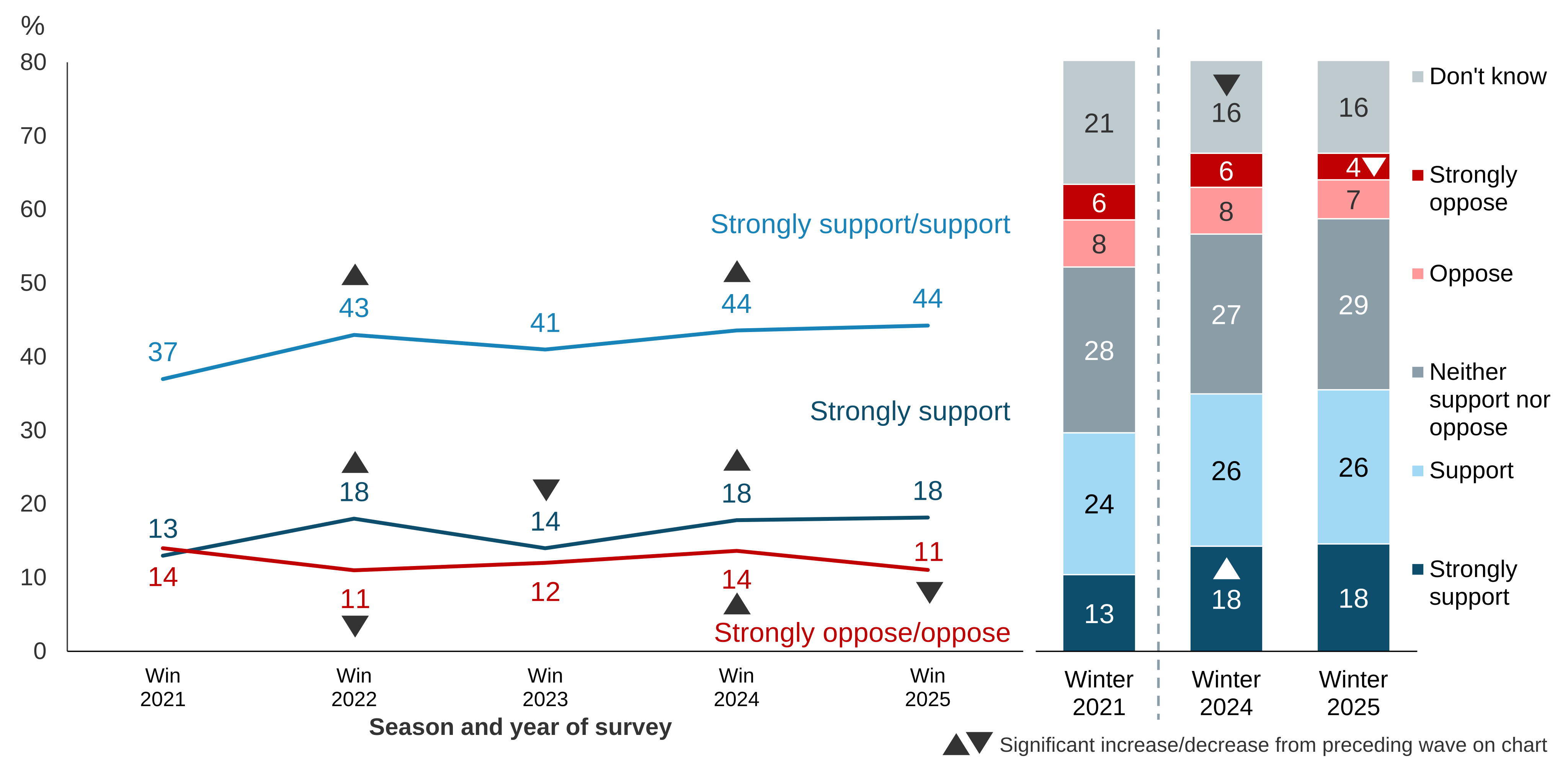 NUCSUPPORT. From what you know, or have heard about using nuclear energy for generating electricity in the UK, do you support or oppose its use? Base: All wave respondents – Winter 2021 (3,703), Winter 2022 (3,570), Winter 2023 (3,731), Winter 2024 (3,211), Winter 2025 (3,277). Note: On the line chart vertical scale has been reduced to 0-80%, and arrows denote a significant difference between one wave and the next. For the bar chart, significant differences are noted between Winter 2021 and Winter 2024, and between Winter 2024 and Winter 2025. Analysis by subgroups Overall support for nuclear energy in the UK was highest for: * Older people: from 49% of those aged 65 and over declining to 39% of those aged 16 to 24). * People with a degree: 53% compared with 35% of those with no qualifications. * People living in the South West (52%); in contrast the lowest levels were reported in the West Midlands (28%). ## Further findings on energy infrastructure and energy security In previous waves, questions were included on other topics relating to energy infrastructure and energy security. The latest findings relating to these topics can be found as follows: * Levels of happiness with electricity network infrastructure being built in the local area and reasons for happiness and unhappiness, see Summer 2025 report on Energy Infrastructure – section on ‘[Awareness and support for new electricity network infrastructure’](https://www.gov.uk/government/statistics/desnz-public-attitudes-tracker-summer-2025/desnz-public-attitudes-tracker-energy-infrastructure-and-energy-security-summer-2025-uk#awareness-and-support-for-new-electricity-network-infrastructure:~:text=about%20a%20topic.-,Awareness%20and%20support%20for%20new%20electricity%20network%20infrastructure,-A%20question%20on) * Levels of concern regarding a range of issues relating to energy security in the next 10-20 years, see Summer 2025 report on Energy Infrastructure – section on ‘[Concerns about energy security’](https://www.gov.uk/government/statistics/desnz-public-attitudes-tracker-summer-2025/desnz-public-attitudes-tracker-energy-infrastructure-and-energy-security-summer-2025-uk#concerns-about-energy-security:~:text=up%20from%2015%25)) * Support for reducing domestic production of oil and gas, even if that means buying more from other countries, see Summer 2025 report on Energy Infrastructure – section on ‘[Support for domestic production of oil and gas](https://www.gov.uk/government/statistics/desnz-public-attitudes-tracker-summer-2025/desnz-public-attitudes-tracker-energy-infrastructure-and-energy-security-summer-2025-uk#support-for-domestic-production-of-oil-and-gas:~:text=any%20specific%20sources.-,Support%20for%20domestic%20production%20of%20oil%20and%20gas,-A%20further%20question)’ * The perceived importance of various aspects of energy policy, see Summer 2025 report on Energy Infrastructure – section on ‘[Perceived importance of different aspects of energy policy’](https://www.gov.uk/government/statistics/desnz-public-attitudes-tracker-summer-2025/desnz-public-attitudes-tracker-energy-infrastructure-and-energy-security-summer-2025-uk#perceived-importance-of-different-aspects-of-energy-policy:~:text=8%25%20and%209%25) * Awareness of greenhouse gas removals (GGRs), see Summer 2025 report on Energy Infrastructure – section on ‘[Awareness of greenhouse gas removals’](https://www.gov.uk/government/statistics/desnz-public-attitudes-tracker-summer-2025/desnz-public-attitudes-tracker-energy-infrastructure-and-energy-security-summer-2025-uk#awareness-of-greenhouse-gas-removals:~:text=vs%2029%25%20respectively) * Attitudes towards fusion energy, hydrogen, small modular reactors, carbon capture and storage, local nuclear power stations and trust in information about emerging energy sources - see Spring 2025 report on [Energy infrastructure](https://www.gov.uk/government/statistics/desnz-public-attitudes-tracker-spring-2025/desnz-public-attitudes-tracker-energy-infrastructure-and-energy-security-spring-2025-uk) 1. It should be noted that the tracking data is not wholly comparable due to a change in the question. The ‘don’t know’ answer code was removed from Winter 2024 onwards to be more consistent with other questions of this style. However, it was erroneously added back in Summer 2025. To ensure comparability with Winter 2024, Summer 2025 results have been